Lion King, Steve.

He was Scar.


We were wrong to believe that the democratic walls of our nation were impenetrable. For we just experienced how quickly a democracy can crack after a catastrophic presidential-election decision. To those who believed that fascism — or perhaps one finds “authoritarianism” more palatable — only arrives in uniforms and jackboots, they were deceived. As last month the U.S. started to walk away from her Republic. Just as Germany did in February of 1933.
Here’s How:
After their installments in January, the 30th and 20th respectively, both Hitler and Trump immediately solidified their grip on power by manufacturing key events and authorizing a series of legislative actions.
~ On February 3rd Hitler met leaders of the Reichswehr –Werner von Fritsch (Army) , Erich Raeder (Navy) and Wilhelm Keitel (Armed Forces) — to present himself as a military leader and ally their suspicions about the Nazi Party. He promised them autonomy, rearmament and revitalization, including canceling the Treaty of Versailles, to secure their support.
~ On February 21st Trump fired senior military leaders, including the judge advocates general of the Army, Navy, and Air Force, not because of any derelictions of duties, but for their failure to demonstrate a personal and political loyalty to him. The plan is install officers who will yield to his interpretation of the law, thus poisoning the military ethe of defending the constitution, being a-political, and offering the “best military advice”.
~ February 20th: The Meeting of the Industrialists. Hitler met with Gustav Krupp (arms), Fritz Thyssen (steel), Emil Kirdorf (coal) and Alfred Hugenberg (media). He promised them wealth protections, large infrastructure projects and favorable economic policies in exchange for financial and logistical support.
~ On January 20th Trump, at his inauguration, placed tech leaders Mark Zuckerberg (Meta), Jeff Bezos (Amazon), Sundar Pichai (Google) and Elon Musk (Tesla/X/Space X) in front of his own cabinet indicting a close relationship and a plan for their direct role in his administration. ~ On February 28th Trump and Musk defended the DOGE’s sweeping cuts to the federal government from the oval office. Musk is not an employee of DOGE, rather a “non-career special government employee” and a political advisor to Trump.
~ On February 27th: The Reichstag Fire was an event orchestrated by Hitler to sow fear and accuse communists of plotting against the German people and government. He used mass arrests to cripple his opponents, including social democrats, trade unionists and Jews. He used that fear to justify measures to “protect” the state.
~ On February 18th Trump falsely accused the democratically elected President of Ukraine, Volodymyr Zelenskyy, of starting the war with Russia and of being “a dictator without election” yet, he called Putin a “genius” for invading Ukraine. ~On February 28th in an “ugly and unprecedented confrontation” in the Oval Office as cameras rolled, Trump and Vance berated and belittled Zelenskyy, saying he’s “ungrateful,” “disrespectful” and “gambling with millions of lives.” Zelenskyy was asked to leave the White House and; after that meeting Trump halted military aid and intelligence sharing with Kyiv. [FYI: English is Zelenskyy’s third language.]
~ On February 28th Germany issued The Reichstag Fire Decree , also known as “The Emergency Decree for the Protection of the German People”. The decree was the legal step that enabled Hitler and The Nazi Party to establish their totalitarian state. The decree suspended freedom of speech, of assembly and of the press and; granted Hitler the power to dissolve political organizations and to eliminate democratic institutions.
~ February 2025: By the end of the month, Trump signed 76 Executive Orders. Orders which dissolve federal institutions, impose sanctions on the International Criminal Court (which holds to account those guilty of committing the world’s worst crimes) impose tariffs on our global allies (Canada, Mexico, European Union), end birthright citizenship, shut down foreign aid (USAID, PEPFAR), close our borders, withdraw from global organizations (WHO,UNHRC, Paris Accord), and claim territory that is not ours: The Gulf of Mexico. These orders, rather than “protect American people”, expand his executive power, erode our democratic institutions and traditions, and dismantle our civil rights.
“President Donald J. Trump will always put the American people first — and through restoring the U.S. military’s mission of lethality and leading with peace through strength in his foreign policy, President Trump is making good on his commitment to restore safety and security around the world.”
The White House, March 4, 2025
Trump’s “peace through strength” justifications do not reflect Ronald Reagan’s Republican words or principles. They reflect the Weltanschauung (worldview) and Lebensraum (concept of expansionism) of Adolf Hitler:
“The iron law of necessity and of the right of the victory of the best and the strongest.” (Mein Kampf )
“Our goal must still be the capture of living space.” (Letter to Field Marshal Wilhelm Keitel, April 29, 1945)
Or as Eberhard Jäckel (German historian) wrote: the blueprint for power.
We are witnessing the toppling of our democracy. We need to stop Trump now. While we still can. By any means necessary.

Trump is a criminal. He’s also a liar, cruel, a business failure, crass and, abusive.
He has the characteristics and the resume that wouldn’t get a person a job in any sector of the workforce. Yet, he won the presidency. A second time. (His previous unsuccessful term notwithstanding.)
I cannot imagine what the U.S. will look like on January 20th, 2025 and after.
The word “retard” will make a comeback. White Nationalist paramilitary groups (fully dressed like cosplayers from Call of Duty) will increase. And everyone will roll out of bed feeling anxious. But for very different reasons.
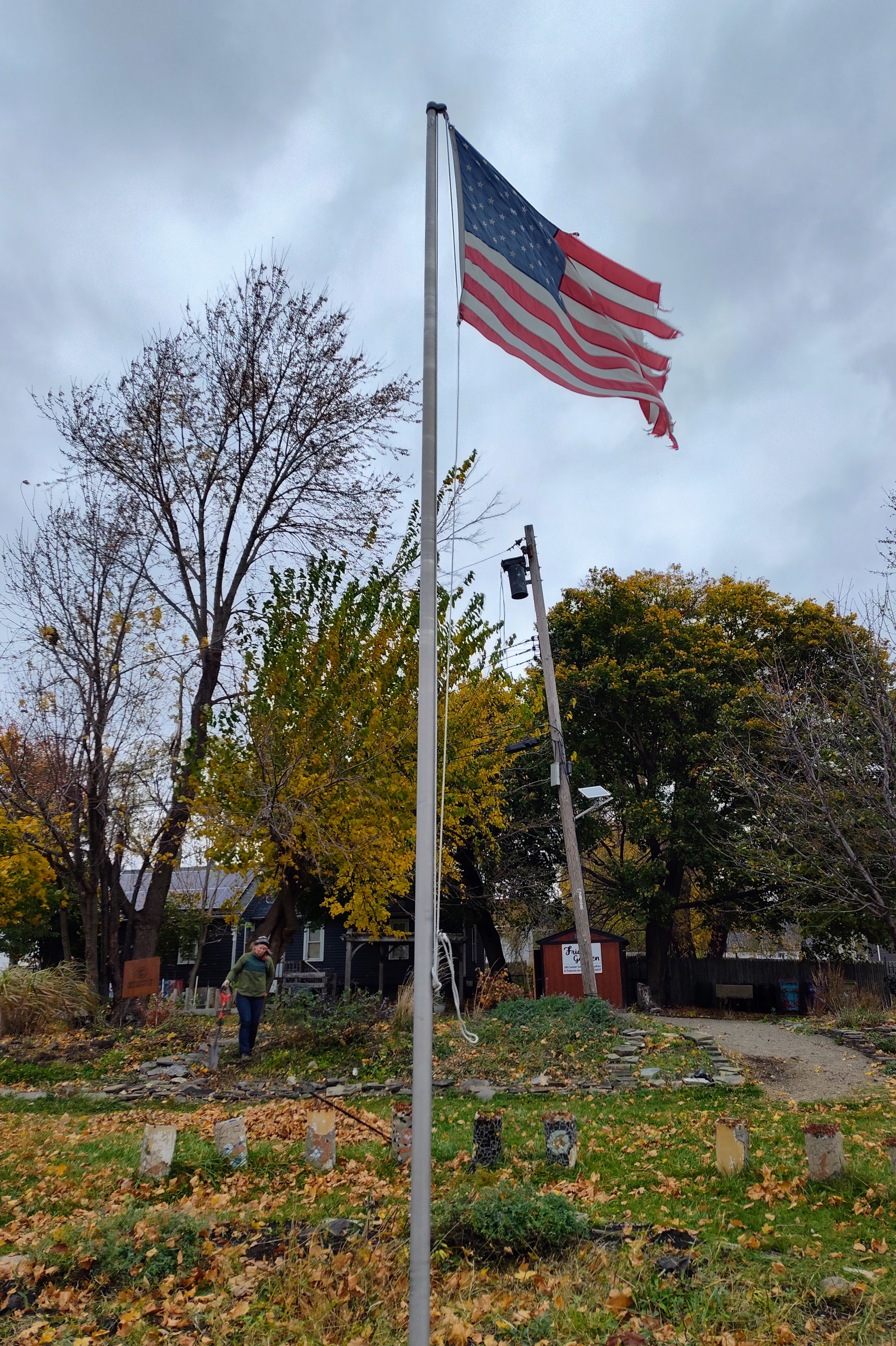
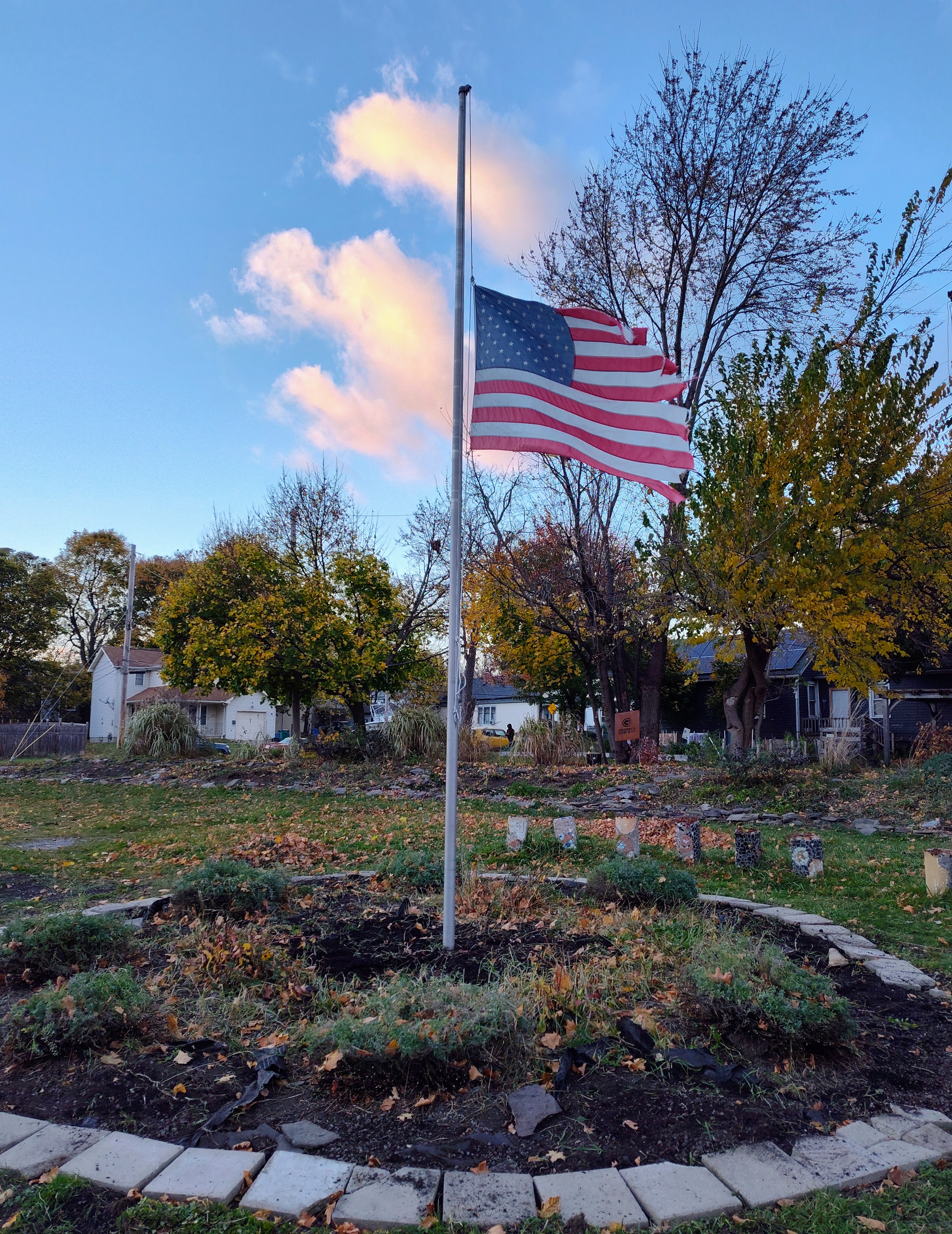
To reduce my own anxiety, I toiled in Frida’s Rebel Garden-Park, a community green space that’s exactly one mile from the Tops Market on Jefferson Avenue, the site of 5/14 Buffalo Massacre. I was pruning the area around the flagpole when the idea of quiet defiance came to mind. I thought of the small acts of resistance used by Black domestic workers to subvert Jim Crow practices.
Those small acts of resistance included throwing away “gifts” from their employees, feigning incompetence about tasks, or working at a very slow pace. The acts themselves were non-confrontational and came with minimal risks. But they allowed the women to push back against inequality, assert their dignity and express a personal agency against oppression.
I followed their example and engaged in my own small act of resistance. It communicates the mourning of the national tragedy that is Trump, and how his presidency will very likely lead our imperfect, yet beloved democratic nation towards destruction.




Simón Rios is an award-winning bilingual reporter and journalist at WBUR, Boston’s NPR news station. He is the son of an Uruguayan father and an American mother.


“[Biden’s] big kill on the Black people is the millions of people that he’s allowed to come in through the border,” … They’re taking Black jobs now and it could be 18, it could be 19 and even 20 million people. They’re taking Black jobs and they’re taking Hispanic jobs and you haven’t seen it yet, but you’re going to see something that’s going to be the worst in our history.”
Blacks and Hispanics want and belong in jobs that are low-paying, offer no workplace protections, put wear and tear on the body, have limited (if any) benefits, offer no job-training, are seasonal and, have a high risk of worker exploitation or abuse.
Agricultural Worker (52%) $13-22/hr.

(30% undocumented, 21% documented)
Agricultural Grader and Sorter (60%) $12-17/hr.

(28% undocumented, 32% documented)
Personal Appearance Worker (63%) $12-18/hr plus tips.
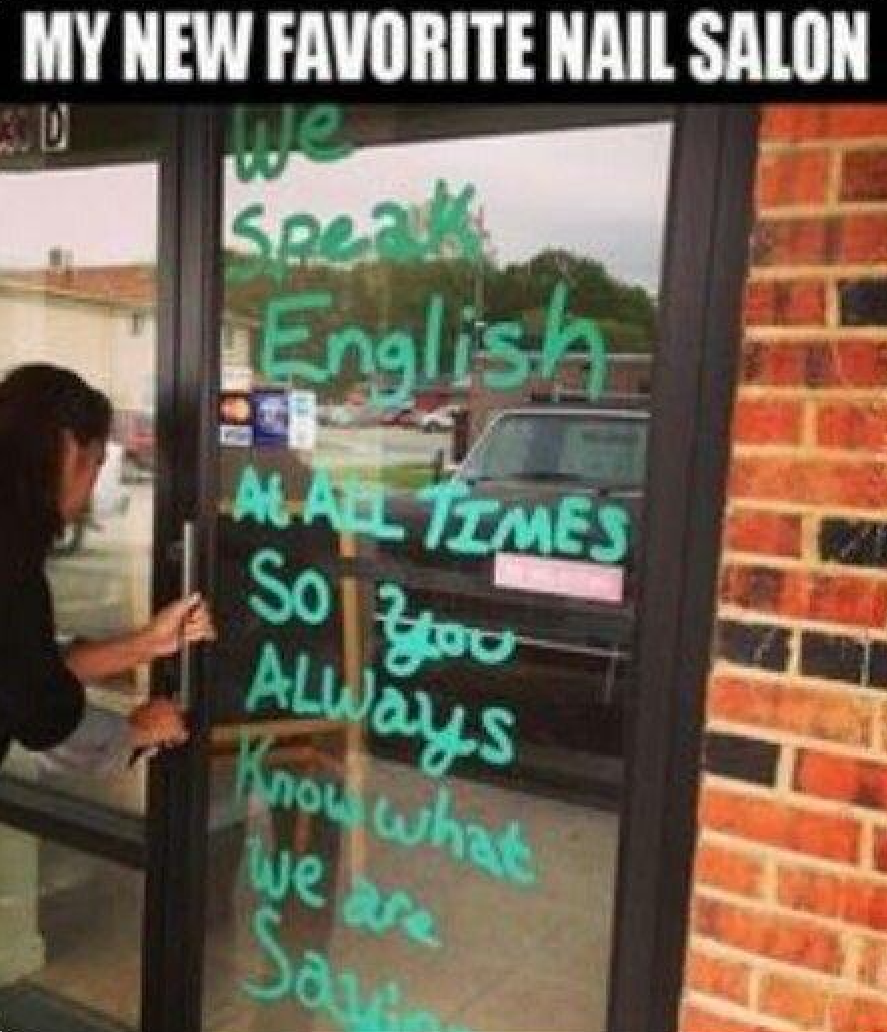
(12% undocumented, 51% documented)
Maid and Housekeeping Worker (50%) $13-17/hr plus tips.

(24% undocumented, 26% documented)
Sewing machine operators (55%) $16-18/hr.

(23 % undocumented, 32% documented)
Plasterer or stucco mason (59%) $12-33/hr.

(36% undocumented, 23% documented)

Rice
Cous-Cous
Peanut Sauce
Onion Sauce
Pate
Gumbo Sauce
Inyam Frites
Baguettes
Beef Brochettes
Goat
Hibiscus Juice,
If we are lucky, Pizza.
The cook who is man and from Niger prepares all the meals for the Peace-Corps Volunteers-in-training (me). I am always worried about being hungry. I get headaches when I am hungry. I hope it is not cous-cous. Good. Nestle Quick to mix and make Carnation powdered milk palatable. I need protein if I am going to survive.
I watched as they killed the goat, its head turned toward Mecca, them whispering,
praying to Allah.
I cannot eat the cooked goat meat.
I find that Mangos are better than oranges and bananas. Fresh plucked from some tree I cannot seem to find in this village called Hamdalaye. I buy the fresh mango from a market woman who does not speak French, Hausa, Zarma or Tomashek. I give her a CFA.
She gives me the mango.
Something is wrong. She is unhappy. She rubs the old bill between her
brown redearthdustdirt fingers.
I am slow.
She has seen that I have other bills, bills which are cleaner, crisper, newer.
She wants a different bill. I give her a newer bill. I get a smile.
I cannot remember if we make eye contact.
“Here is a list of physical education (éducation physique) vocabulary words you will need to know in French:
high jump: saut en hauteur,
offense: l’attack,
long jump: saut en longeur,
start: début,
guard: la défense,
finish: fin,
triple jump (girls are not allowed to perform the triple jump because it could interfere with their ability to make babies): triple saut.”
An excursion to the capital of this African nation called Niger, which is not to be confused with Nigeria. It sits along the Niger River. We are told we will find the Grand Marche, the american embassy, the u.s. consulate, a u.s. marine base, the Hotel Sofitel, a French anasara store, the american cultural center, the Petite Marche, rip-off row, and the Stade.
We are again a herd — without the docile faces or lumbering bodies. We move quickly and with determination. We will not miss out on anything.
“Americans do everything like a business.”
An opportunity to shop for: chocolate, fabric, gifts for our families. (Finally.)
I buy chocolate and cloth. I privately, secretly, think the cloth is ugly. It is purple. It has a pattern not unlike paisley. I call it faux-paisley. I know I will never wear it as a pagne. Maybe, maybe, I will get a dress made by a tailor. I eat the chocolate in the van on the way back to our compound in the village of Hamdalaye. I am disappointed. I do not like the taste.
As a special treat we are taken to the u.s. ambassador’s house, which is really an estate.
“His” property is:
“The loveliest piece of property in Niger. It overlooks the Niger River, has mango trees which bear fruit, and actually has green grass. Peace Corps Volunteers, not Peace Corp administration, are allowed to come any time during the day to swim in his in-ground pool. Just show the guard your Peace Corps ID and he will let you in. Be sure to greet the guard with the proper greeting:
‘Al-hamdalaylaye’”.

The ambassador throws a special July 4th party for the volunteers and the volunteers-in-training.
There is budweiser beer. There is a barbecue. There is a softball game.
The ambassador likes the Peace Corps Volunteers.
I swim in the ambassador’s pool. I am thinking of the “Things you will need to bring to Niger.” list. I cannot remember if if “bathing suit” was on the list. I am thankful I brought one.
I drink a lot of this stale, aluminum-tasting beer.
I never liked beer.
I do not play softball.
I never liked softball.
I like the grass. It grows over the redearthdustdirt because the lawn is constantly sprinkled with water, even though half of Niger is a desert, the Sahara, and the other half is a scrubby half-desert, the Sahel. The grass is prickly and grows in clumps. It is not all comfortable to lay on. I imagine it as a small act of resistance from the redearthdustdirt. No soft, green, chem-lawn, for mr. ambassador. I am happy for this small act. I suddenly desire to see more of it.
Like a wall it is moving toward us. Truly. I can see the clear, blue, sky, and the huge, red, sun above it. A dust storm! It is the REDEARTHDUSTDIRT coming. It is coming for me. It is our secret. I know it. I am ecstatic. I am being pushed in a cab by someone, a worried Black Nigerien, who saw my white face and was scared for me. I was not scared. I am packed into a cab with volunteers I do not remember. It is all around us. I imagine it is my redearthdustdirt. It is black. There is blackness inside this wall of redearthdustdirt. And, I remember. I am in the heart of Black Africa. And I laugh. I like this blackness.
It is gone.
To be continued...

“You gon’ come to our city and decide you don’t like Black people. Man, you don’t know a damn thing about Black people…We never go to no neighborhoods and take people out.”
Barbara Massey Mapps, sister to victim Kat Massey, 2/15/2023
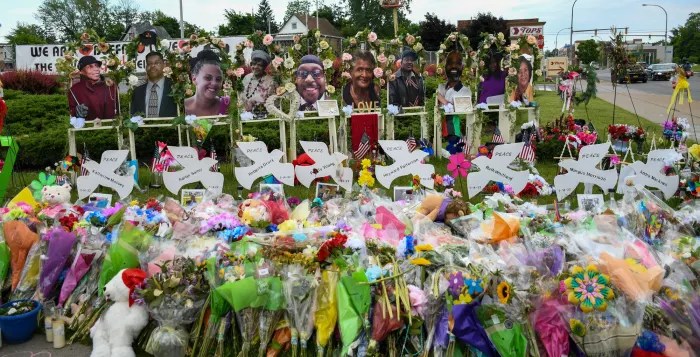
Two years ago on 5/14 a white boy drove 200 miles to Buffalo in a military kit worth over $2000 to kill Black people. Which he did. On that day, at approximately 2:30 pm, hundreds of lives were ruptured. Personal life stories are now framed by “before” and “after”. Or as survivor Fragrance Stanfield said, “The person I was literally died on May 14th and I am a different person. I am somebody else.”
The counter to the massacre by the victims of that day is humbling. They’ve been speaking about their love for those who died, exposing their raw wounds, and sharing their struggles for survival — for some against leaving the house, for others against using alcohol to numb their pain — since and still.
Imagine what it takes to make one’s grief, pain and rage so public just to get people to see the ugly reality and danger of White Supremacy. “White supremacy”. Words insufficient to the describe the insidious and often silent character of its power. A power not of individual White people but, a power of ideas, values, and most importantly practices. (Even so, we Whites know that we live our lives with a certain kind of ease and without a certain kind of pain.)
Next, listen to Mr. Garnell Whitfield, Jr., whose 86 year-old mother, Mrs. Ruth E. Whitfield, was murdered that day:
“Remember where this country came from. Remember what’s been done to us. Generationally. Remember that. You want to honor my Mom’s legacy? Remember where she came from and how she had to struggle her entire life because she was a Black woman in America. Remember, she died, not being completely accepted and free.”
Deserving of acknowledgement are those who have forced their wounds into calls for justice and action. Think of The Pursuit of tRuth Conference or the food drives by the children of Geraldine Talley along with the non-profit, Agents for Advocacy, started by her son, Mark. Think of The Lieutenant Aaron Salters Memorial Scholarship Foundation, established by Salter’s lifelong friend and colleague, Earl Perrin, Jr. or the vacant city-owned lots that are now maintained by Damone Mapps, in honor of his murdered aunt Kat Massey, who cared for them when she was alive. Think of NPR’s “Buffalo, What’s Next?”
Turning anguish into action, out of survival, is something Black Americans have done since their enslaved bodies were first brought to this land. Think of Margaret Garner, who in 1856 killed her two-year old daughter with a butcher’s knife rather than see her returned to slavery. Think of Mamie Till, who in the midst of her grief insisted that the casket containing Emmett’s brutalized body be left open because, in her words, “I wanted the world to see what they did to my baby.”
For too many, still, Black lives don’t matter.
At last year’s “Moment of Remembrance” I watched the faces of the seated guests of honor — relatives of the murdered and wounded — as they listened to the elected officials that spoke. Mayor Byron Brown, Governor Kathy Hochul and U.S. Senator Chuck Schumer. They looked exhausted sitting under that tent, feeling the weight of the air and the weight of the day. Again, they tempered their rage and made public their grief. With the police presence so heavy it felt like an intrusion.
I left. I do not know how the families or Black Buffalo got through not just that memorial, on that now sacred tarmac, but that day — Mother’s Day no less.
I think of the victims’ direct descendants. They will carry the weight of the personal, collective, and cultural trauma of that day and its aftermath. They will inherit 5/14 as a post-memory. They will absorb many of the stories, images, and feelings as if they were their own. 5/14 will become their dominant experience and their invested narrative.
That man/boy who did this, and all of his accomplices, should be charged with the crime of causing generational trauma.
To commemorate 5/14 we must stay present and honor those who died and those who survived. We must remember that 5/14 is still so very raw for so many people. We must salute the collective responses to such hate. Lastly, we must acknowledge and honor the continuous history and legacy of Black love and Black resistance.

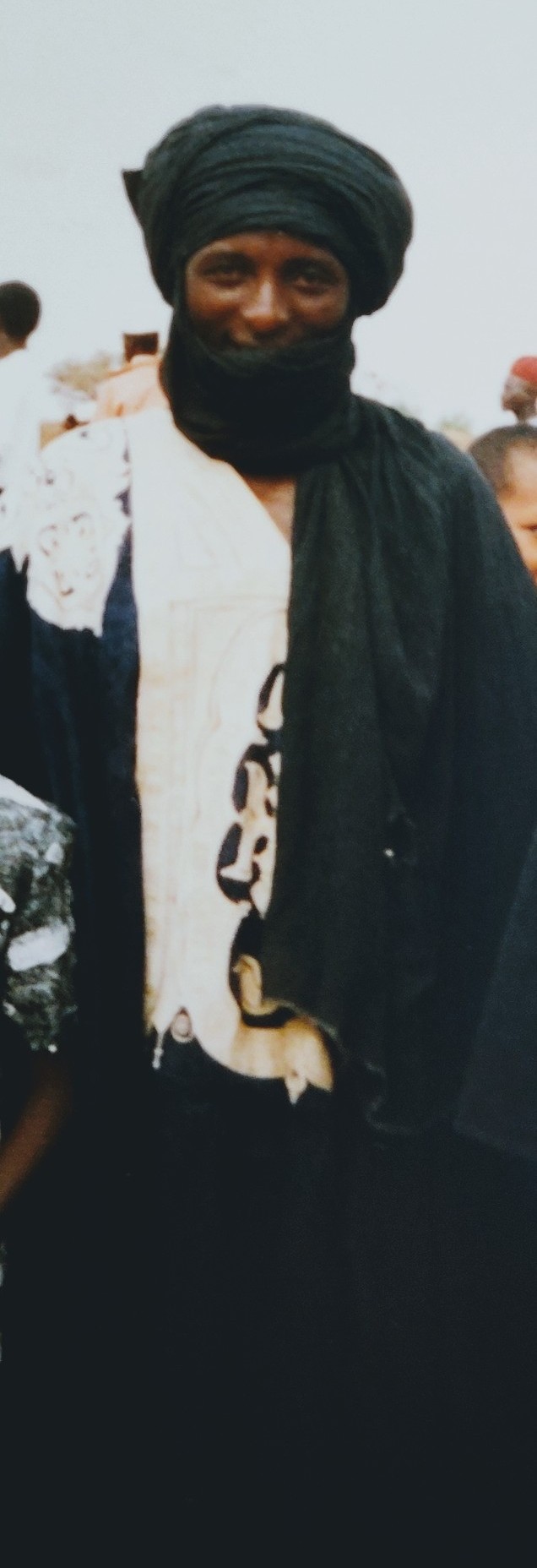
Issafou, the “dark-skinned”, Tuareg. Hired by Peace Corps to guard their compound.
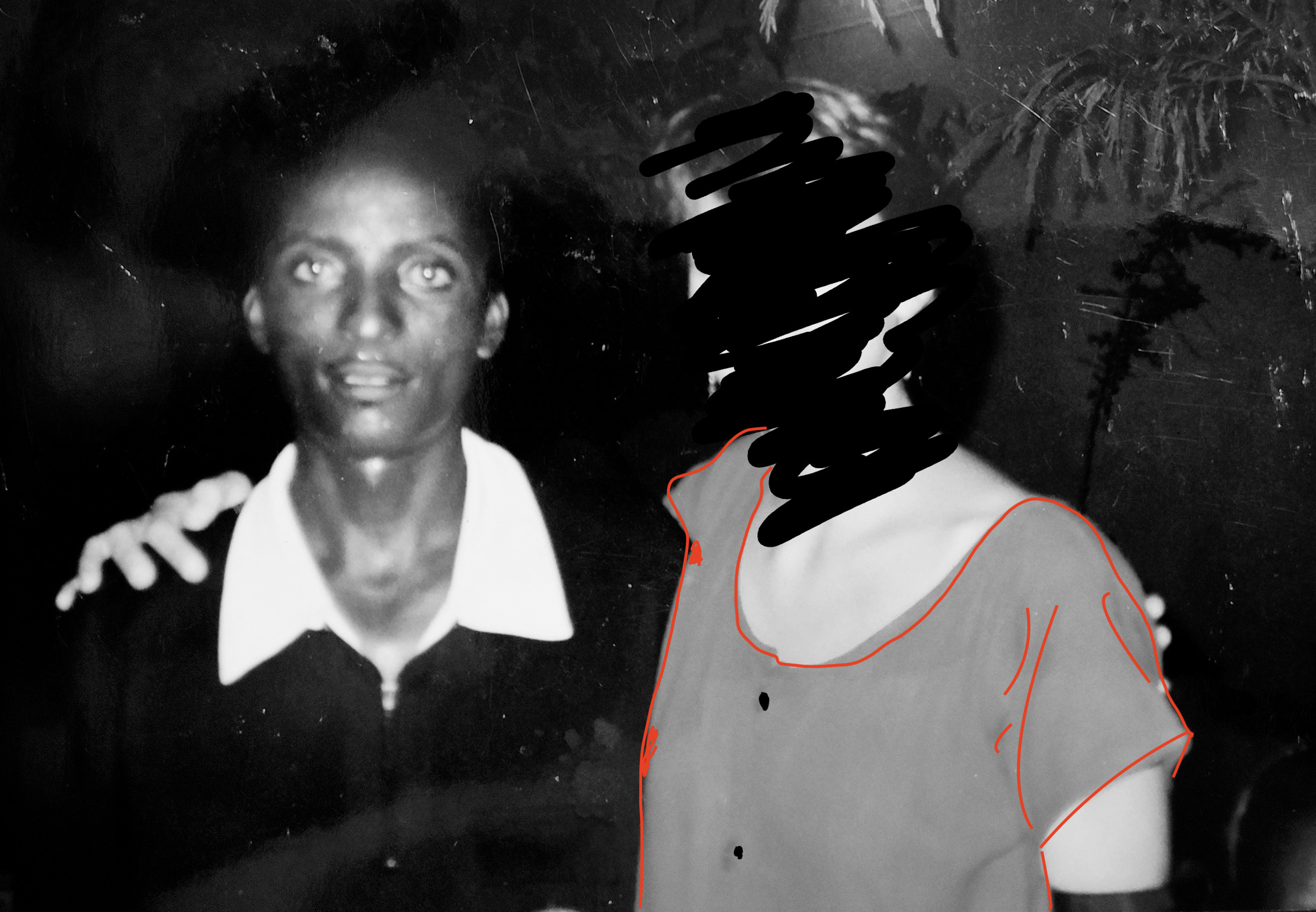
Issafou and me. I’m wearing my red dress.

I am to be tutored in French language. Zarma language. If time, Hausa Language. And, Nigerian culture. We Peace Corps Volunteers-in-training are herded into groups of three or four, depending on our roles to be.
I am going to be a Youth Worker.
I am going to be a Youth Worker who is a Physical Education Teacher.
“Education de Physique et Sport.”
I am going to teach young boys and girls how to play basketball!
We, I, are, am taught in cute little huts that protect us from the huge red sun. Issa taught us, me language.
“Je suis American. Corps de la Paix. Je m’appel Beth.
Mata fu. Mata goy. Ima Beth.”
We, I, are, am taught in cute little huts that protect us from the huge red sun. Mamadou taught us, me culture. Only, I am alone for this special lesson.
“Nigerien men are first class citizens.”
“American men are first class citizens.”
“Nigerien women are second class citizens.”
“American women are third class citizens.”
This special lesson tells me I have a special place.
We, I, are, am taught in cute little huts that protect us from the huge red sun. A soon-to-be exiting PCV taught us, me physical education techniques.
“Use colored headbands to organize the kids into teams.
Equipe Rouge. Equipe Blue. Equipe Verte. Equipe Jaune.”
“Most of your students will not have sneakers. Try to discourage them from wearing their flips-flops so they don’t stub their toes when they are running.”
To be continued…
To read this peace in full go to the title on the menu page.

In 2023, PopCorners (a snack brand owned by PepsiCo) created an ad for Super Bowl LVII, which was a spoof on the American crime drama series Breaking Bad.
Description from the YouTube video states:
“One of the best-received commercials during the Super Bowl featured a call back to one of the best television shows of all time. PopCorners recruited Bryan Cranston and Aaron Paul to reprise their Breaking Bad characters for the ad.
In the commercial, Walter White and Jesse Pinkman are in their famous trailer, but instead of manufacturing crystal meth, they are making PopCorners snacks. However, White and Pinkman need to find a distributor for their creation, so they call another familiar face.”
What shocked me, was in the middle of the ad, the character of Walter demands that the character Tuco,

(The ad is available for viewing on the PopCorners website.)
Who wrote this ad?
Who approved this ad?
The phrase, “Say Their Name(s)” was popularized to bring attention to victims of police brutality, especially to the human rights violations by police towards Black and Brown people. This includes beatings, racial abuse, unlawful killings, torture, or indiscriminate use of riot control agents at protests.
The 21st century resistance to police brutality began with the 2014 movement SayHerName, the response to the death of Sandra Bland, who died while in police custody.
The phrase has not only gained traction when discussing police brutality, but has become eponymous with the Black Lives Matter movement. A movement, The New York Times writes, “that may be the largest social movement in the history of the United States”. (They report that about 15 million to 26 million people in the United States have participated in demonstrations over the death of George Floyd alone.) It is a movement archived in the Library of Congress.

The phrase Say Their Names itself serves multiple purposes: it is a form of protest, a demand for justice, and a communal act of mourning. By invoking the names of the deceased, such as Michael Brown, Eric Garner, Sandra Bland, and many others, the community asserts their humanity, insists on the recognition of their unjust deaths, and calls for accountability from the systems that failed them.
The practice of calling out the names of the dead in a public or communal setting has deeper roots in African traditions, where the spoken word is believed to hold power. In many African cultures, naming is considered a vital act that connects an individual to their community and their ancestors. The act of speaking a name aloud can be seen as a way to honor the deceased and ensure they are not forgotten.
This form of ritualized remembrance is also reminiscent of religious and spiritual practices found in many cultures around the world, where saying the names of the dead is believed to help in the mourning process and in some beliefs, aid in the journey of the soul.
In the context of African American history, this practice takes on additional layers of significance given the long history of systemic violence and oppression. It serves as a form of resistance and a declaration that these lives mattered, directly challenging narratives that might seek to undermine or minimize the significance of their lives and deaths.
The use of Say Their Names in protests and memorials continues to be a potent reminder of the need for change and the ongoing struggle for racial justice and equality in America.
How did the creators of this ad not know this? Why did Pepsico approve this ad? Did they not learn from their 2017 tone-deaf ad that used imagery from the Black Lives Matter movement? They pulled that ad after a day of intense criticism arguing that it trivialized the widespread protests against the killings of Black people by the police.
And, where was the backlash for the PopCorners ad?
This is what it means to be White in America. You can have a short memory. You can have a short attention span. Black suffering continues to be normalized and minimized. Powerful protest rhetoric once again becomes reduced to a pool of slang for advertisers to pull from.
And still, police continue to kill people during arrests. The numbers are increasing. Police in the US killed the highest number of people on record in 2023. And, Black Americans are still killed at a much higher rate than White Americans. On April 26th, the news agency Reuters reported “Ohio police released video of a Black man who died at a local hospital after repeatedly telling officers “I can’t breathe” as they pinned him to the floor of a bar and handcuffed him. ” Write his name: Frank Tyson.
Say Their Name should never be used to advertise popcorn or any other product. Ever.

In late March, The New York Times published an opinion piece written by David Brooks, Canadian-born American conservative political and cultural commentator, titled “The Great Struggle for Liberalism”. It is love-letter to liberalism . It is full of omissions, lies, vagaries and myths.

https://www.nytimes.com/2024/03/28/opinion/liberalism-authoritarianism-trump.html
The best way I know how to respond is to comment and grade. His words are in black. My words are in red and blue (and pink and brown).
In 1978, Russian dissident Alexander Solzhenitsyn gave a commencement address at Harvard, warning us about the loss of American self-confidence and will. “A decline in courage may be the most striking feature that an outside observer notices in the West today,” he declared. Define “the West”. (This was during the Carter administration.) Today, those words ring with disturbing force. What was Solzhenitsyn’s context?
The enemies of liberal democracy seem to be full of passionate intensity – Vladimir Putin, Xi Jinping, Donald Trump, campus radicals. Define who you see as “campus radicals”: Alt-right groups; Pro Palestine groups; Anime societies? How are campus radicals “enemies” to liberal democracy, especially as you conflate/compare them to three global state authoritarians?
Meanwhile, those who try to defend liberal norms can sometimes seem like some of those Republicans who ran against Trump in the 2016 primaries – decent and good (poor choice of words), but kind of feckless and about to be run over. Define “liberal norms”.

Into this climate emerges Fareed Zakaria’s important new book, “Age of Revolutions: Progress and Backlash From 1600 to the Present.” One of the powerful features of this book is that Zakaria doesn’t treat liberal democratic capitalism as some set of abstract ideas. He shows how it was created by real people in real communities who wanted richer, fuller and more dynamic lives.
I find this paragraph problematic. First, you conflate “liberal democracy” with “liberal democratic capitalism”. Democracy and Capitalism are two distinct systems of government. At their core, they are incompatible. Democracy recognizes each citizen’s rights, worth and dignity. Capitalism is made up of two classes of investor: capital and labor. Political rights to govern are held by the legal vehicle of the corporation. Which, in the U.S., were given the same rights of “personhood”. The only citizens who matter are those who own capital: shareholders.
Also, you assume capitalism is the right way and possibly the only way to organize an economy.
His story starts in the Dutch Republic in the 16th century. The Dutch invented the modern profit-seeking corporation. The Dutch merchant fleet was capable of carrying more tonnage than the fleets of France, England, Scotland, the Holy Roman Empire, Spain and Portugal combined. By the 18th century, Amsterdam’s per capita income was four times that of Paris.
This paragraph is deeply concerning. It is what is called “a-historical”. You cannot exclude the role the Dutch played in the transatlantic slave trade. The Dutch merchant fleet carried over a half a million Africans across the Atlantic. Their participation in the marketing and trading of enslaved Africans is what allowed for that increase in “per capita income”, thus making the Netherlands an economic world power.
To ignore and dismiss the slave trade is not acceptable. It presents a false history. It ignores the generational wealth accumulated by the slave trade. It denies the repression and demise of numerous African cultures. It erases the destruction the political, economic and material power of African nations . It belies the wealth created by the goods produced on the plantations by the back-breaking labour of the enslaved: sugar, coffee, tobacco, indigo, cacao and more.
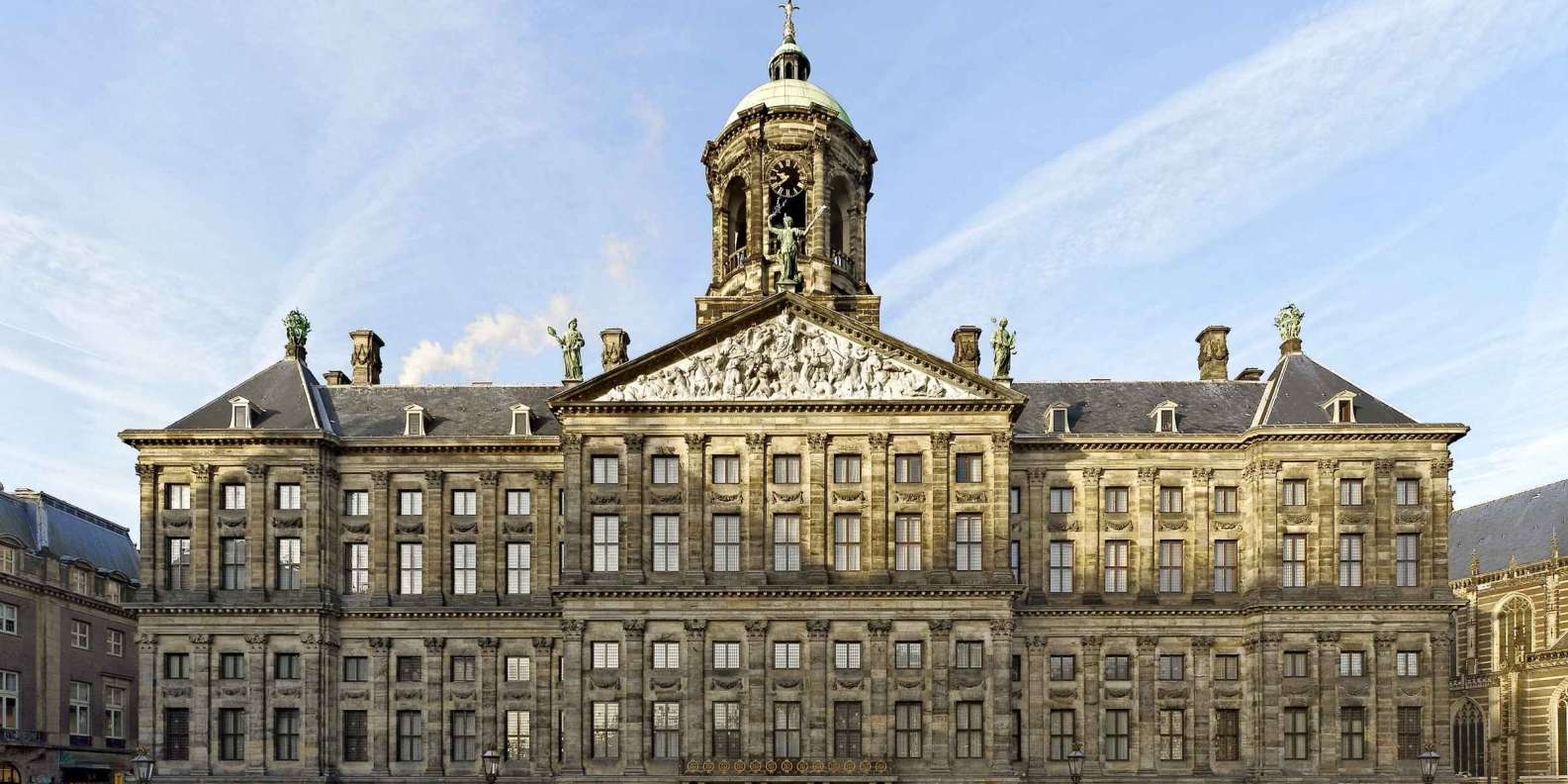
The Royal Palace which housed the Society of Suriname, the governing body of the colony of Suriname. The Society did so on behalf of the colony’s owners, among which was the city of Amsterdam itself.

The headquarters of the Dutch West India Company. The Dutch state awarded the WIC with a monopoly on the trafficking of more than half a million enslaved humans from several parts of Western and Central Africa to The Americas.
The gross injustices of the transatlantic slave trade still define, defend and shape our current economic, political, social, religious and material worlds.
Dutch success wasn’t just economic. There was a cultural flowering (Rembrandt, Vermeer). There was urbanization – the building of great towns and cities. There was a civic and political stability built around decentralized power. There was a relatively egalitarian culture – until the 19th century, there were no statues of heroes on horseback in Holland. There was also moral restraint. Dutch Calvinism was on high alert for the corruption that prosperity might bring. It encouraged self-discipline and norms that put limits on the display of wealth.
Again, a very a-historical analysis/description. The “Dutch Golden Age” of which you are referring, ignores the foundation upon which it was built: the slave trade. Thus It is hard to accept your description of this society being “civil”, “egalitarian” and of “moral restraint”. (No statues not withstanding.)
Such descriptions make invisible the brutality and horror of the slave trade. As if the terror and trauma of it all need not be mentioned, let alone be described.
The next liberal leap forward occurred in Britain. FYI: British involvement in the transatlantic slave trade began in 1562 and by the 1730s Britain was the world’s biggest slave-trading nation. In the Glorious Revolution of the late 1680s, a Dutchman, William of Orange, became King of England and helped import some of the more liberal Dutch political institutions, ushering in a period of greater political and religious moderation. Once again, you see the same pattern: Technical and economic dynamism goes hand in hand with cultural creativity, political reform, urbanization, a moral revival and, it must be admitted, vast imperialist expansion. No! Imperialist expansion needs to be centered! Cultural creativity, political reform, urbanization and moral revival for whom? (Certainly not women.) British inventors and tinkerers like James Watt perfected the steam engine. From 1770 to 1870 real British wages rose by 50%, and over the first half of the 19th century, British life expectancy increased by about 3.5 years. You are cherry-picking. The Industrial Revolution did bring wealth. But, it was wealth produced on the exploitation of labor by men, women and children.

The great reform acts in the 1800s gave more people the right to vote and reduced political corruption. The rise of, for example, the evangelical Clapham Sect in the early 19th century was part of a vast array of social movements led by people who sought to abolish the slave trade, reduce child labor, reform the prison system, reduce cruelty to animals, ease the lives of the poor and introduce codes of propriety into Victorian life. To reduce the abolition of slavery to a social reform movement minimizes slavery’s impact on every aspect of global culture: past and present. America was next, and the pattern replicated itself: new inventions like the telephone and the electric lightbulb. People flooding into the cities. The driving force behind the Black mass movement into the cities was to escape racial violence, pursue economic and educational opportunities, and obtain freedom from the oppression of Jim Crow. During the 20th century, American culture dominated the globe. Thanks in part to the postwar American liberal order, living standards surged. Why did living standards increase? Identify the rights revolutions that were occurring. As Zakaria notes, “Compared to 1980, global GDP had nearly doubled by 2000, and more than tripled by 2015.” The global GDP is not a reflection on the distribution of wealth. (The net worth of the world’s five richest individuals, all men, has shot up from $405 billion to $869 billion since 2020. That is a rate equivalent to about $14 million per hour. This cannot be dismissed.)
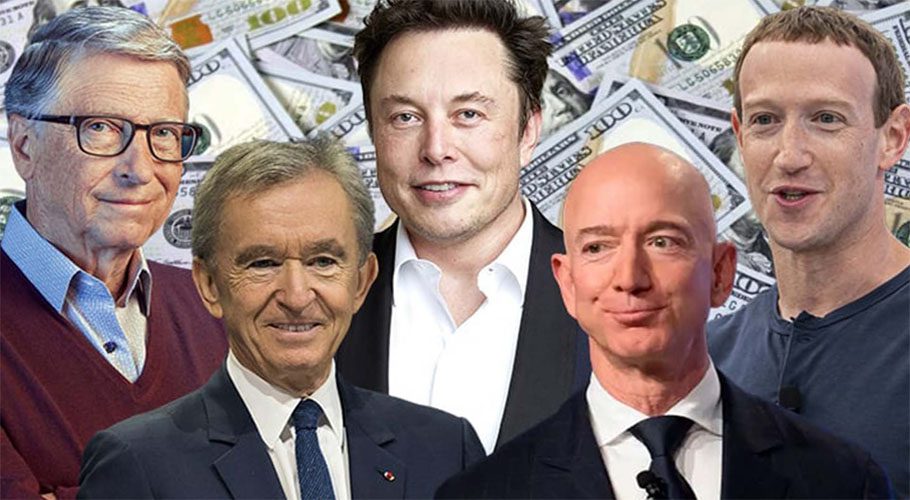 Larry Ellison, Bernard Arnault, Elon Musk, Jeff Bezos, Mark Zuckerberg
And yet for all its benefits, liberalism (which are…) is ailing and in retreat in places like Turkey, India, Brazil and, if Trump wins in 2024, America itself. You are conflating liberalism with democracies. These nations all identify as having representational democracies with free elections. Saying so does not make it so. Zakaria’s book helped me develop a more powerful appreciation for the glories of liberalism, and also a better understanding of what’s gone wrong. The glories of liberalism for whom?
I’m one of those people who subscribes to Austrian psychiatrist Viktor Frankl’s doctrine: “Man’s search for meaning is the primary motivation in his life.” To feel at home in the world, people need to see themselves serving some good – doing important work, loving others well, living within coherent moral communities, striving on behalf of some set of ideals. This paragraph does not fit. You are trying to make an argument that liberalism creates “progress”. Introducing vague ideas regarding the “meaning of life” make your argument a-contextual. And, more importantly, material conditions irrelevant.
The great liberal societies that Zakaria describes expanded and celebrated individual choice and individual freedom. But when liberalism thrived, that personal freedom lay upon a foundation of commitments and moral obligations that precede choice: our obligations to our families, to our communities and nations, to our ancestors and descendants, to God or some set of transcendent truths. This is a new and different argument. Here you are introducing the concept that liberalism works when its foundation lays on the interest of the greater good of the other. Yet, obligations to family, community, nation, ancestor, Gods, are often conflicting or mutually exclusive. So, as the reader, I am confused. For example, why is it okay for Nestle to privatize water?

Image detail from book cover: “The Age of Commodity: Water Privatization in South Africa”. Editors Greg Ruiters and David McDonald.
Over the past few generations, the celebration of individual freedom has over spilled its banks and begun to erode the underlying set of civic obligations. Especially after World War II and then into the 1960s, we saw the privatization of morality – the rise of what came to be known as the ethos of moral freedom. Give examples, please. Americans were less likely to assume that people learn values by living in coherent moral communities. They were more likely to adopt the belief that each person has to come up with his or her own personal sense of right and wrong. As far back as 1955, columnist Walter Lippmann saw that this was going to lead to trouble: “If what is good, what is right, what is true, is only what the individual ‘chooses’ to ‘invent,’ then we are outside the traditions of civility,” he wrote. What is your point? Are you talking about cultural issues? Right and wrong in what context? What did Lippmann mean by “civility”. (It is interesting that you quote Lippmann: he believed that “intellectual elites” undermined democracy. Those elites being Liberals.)
Trust is the faith that other people will do what they ought to do. That is not trust. That is expectation, assumption and at times, hope. It reeks of self-interest. Trust is believing that someone will not hurt you. When there are no shared moral values and norms, then social trust plummets. How then do we live with difference? People feel alienated and under siege, and, as Hannah Arendt observed, lonely societies turn to authoritarianism. This statement reduces and distorts Arendt’s analyses. People eagerly follow the great leader (Who decides if a leader is great?) and protector, the one who will lead the us/them struggle that seems to give life meaning. The Germans considered Hitler a great leader and followed him because their economy was in ruins following the global Great Depressions and The Treaty of Versailles’ demand for financial restitution. They believed he would bring an end to Germany’s humiliation and restore The Fatherland to its glorious Nordic imagined past and; as a nation of a master race of racialized aryans.
During our current moment of global populism, the liberal tradition is under threat. Positioning populism and liberalism as binary constructs a false equivalency. Many people have gone economically nationalist and culturally traditionalist. Around the world, authoritarian moralists promise to restore the old ways, the old religion, national greatness. It is not just “authoritarian moralists” who make such promises. The defense of and the return to the “old ways” are used by conservatives, traditionalists, moderates and neoliberals. It is an argument often used by those who are opponents of radical change. “There are certain things which are more important than ‘me,’ than my ego – family, nation, God,” Viktor Orban declared. Such men promise to restore the anchors of cultural, moral and civic stability, but they use brutal and bigoted strongman methods to get there. Again, not just the strategies used by “brutal and bigoted strongman”. You are contributing to the binary, either/or thinking that is endemic to Western thought.
President Biden tried to win over the disaffected by showering them with jobs and economic benefits. It doesn’t seem to have worked politically because the real absence people are feeling is an absence of meaning, belonging and recognition. Unsophisticated argument. There exists, as never before, a real lack of healthy material conditions: lack of living wages, food price gouging, rent gouging, unhealthy neighborhoods, job insecurity, the gig economy, and more. You cannot have it both ways. You cannot write a piece about liberal economics and use tropes of happiness to defend your argument.
This election year, in the United States and around the globe, will be about whether liberalism can thrive again. No. The U.S. election is not about whether or not “liberalism can thrive”. This election is about whether or not Fascism continues to thrive. The battle is between the Left and the Right. Zakaria’s book will help readers feel honored and grateful that we get to be part of this glorious and ongoing liberal journey. He understands that we liberals can’t just offer economic benefits; we also have to make the spiritual and civic case for our way of life. He writes: “The greatest challenge remains to infuse that journey with moral meaning, to imbue it with the sense of pride and purpose that religion once did – to fill that hole in the heart.” I would encourage you to read the message of His Holiness, Pope Paul VI, for the Celebration of the Day of Peace on January 1, 1972.
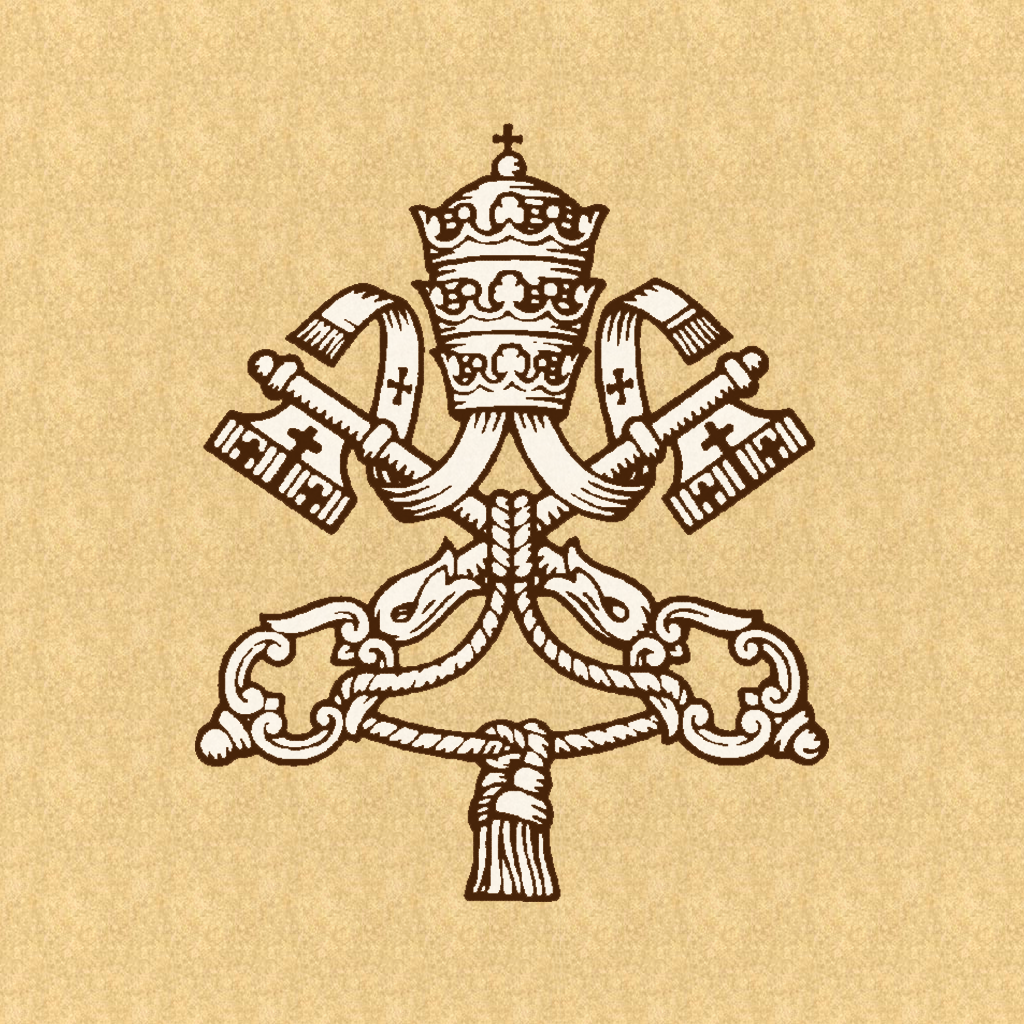
IF YOU WANT PEACE, WORK FOR JUSTICE
There’s glory in striving to add another chapter to the great liberal story – building a society that is technologically innovative, commercially daring, with expanding opportunities for all; building a society in which culture is celebrated, families thrive, a society in which the great diversity of individuals can experience a sense of common purpose and have the space and energy to pursue their own adventures in living. Blah, blah, blah…meaningless, empty statement.
Final Comments:
Fareed Zakaria believes in progress, the idea that history has a tendency and/or movement toward freedom. And, that it proceeds in the direction of improved material conditions and a better life for all people, eventually. This appears to be your standpoint. Such a standpoint often legitimizes and ignores violence: historical and modern day. And, racial violence especially. Your piece is a classic example.
Your piece is a-historical and a-contextual, thus lacking critical thought.
Of course, an opinion piece is just that, an opinion. But, it has credibility only if one’s point is clear, well researched and has deep levels of argument.
Final Grade: 

How Black and Brown people celebrate Martin Luther King, Jr. Day:

How White people celebrate Martin Luther King, Jr. Day:

How the Buffalo News celebrates Martin Luther King, Jr. Day:
1/15/24 Buffalo News Front Page.
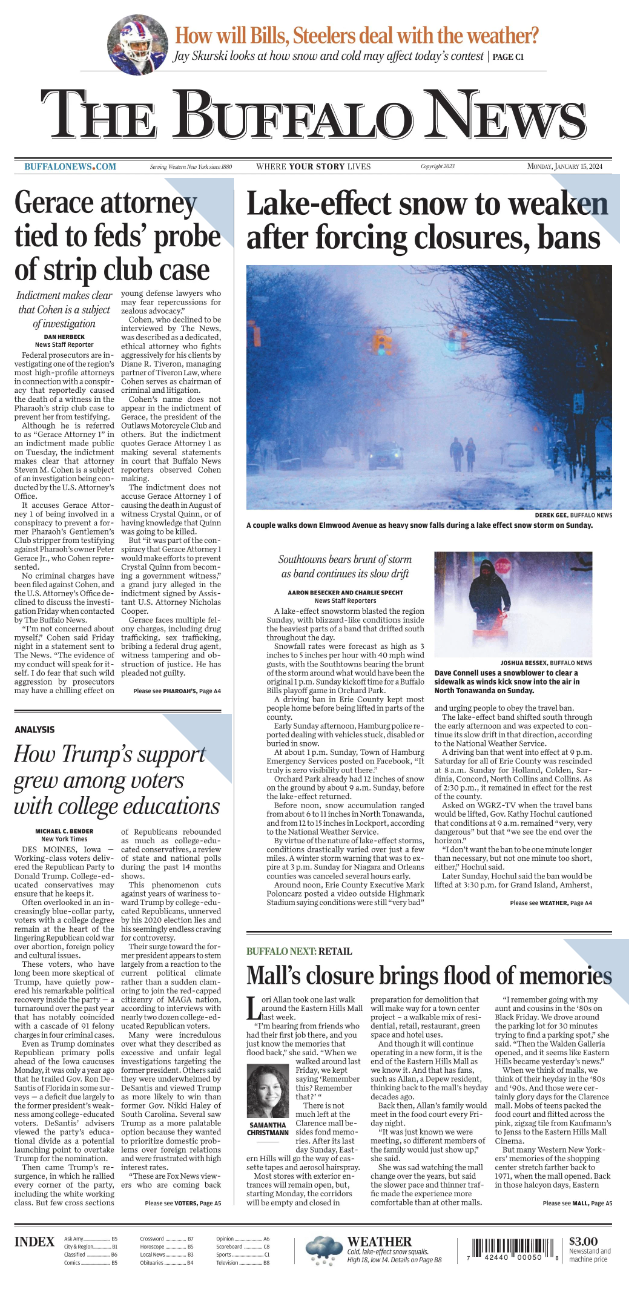
They don’t.

How should we remember 9/11?
It is a day for remembering and honoring. It is a day for learning lessons from the past. It was a tragedy. Most of us know the death count: over 3,000 in NYC, 125 in the Pentagon, and 265 in Shanksville, PA. A tragedy of terrorism unlike any other in the history of the continental United States.
Yet, we cannot forget that we turned our tragedy into a travesty. A global travesty. We engaged in a needless war in Iran looking for weapons of mass destruction that did not exist. We engaged in a twenty-year war with the Taliban in Afghanistan that left over 166,000 dead (of which 47, 245 were Afghan civilians) and left the Taliban in rule.
The Middle East and her Muslim citizens were deemed Public Enemy #1, fanatical and anti-modern. Our nation became a surveillance state via the passage of laws that allowed for warrantless wiretapping, mail cover, information extraction from private computers and data mining from social media networks. Lastly, anti-Muslim, anti-Asian, and anti-Black hate crimes committed by White Americans increased exponentially under the patriotic guise of White Nationalism.
Lastly, we reduced anti-Americanism in the Third World to the simple and simplistic notion of jealousy. Or as President Biden stated commemorating 9/11 at a military base in Anchorage, Alaska; “That’s why the terrorists targeted us in the first place — our freedom, our openness, our institutions.”
So, how should we remember 9/11?
A must read…
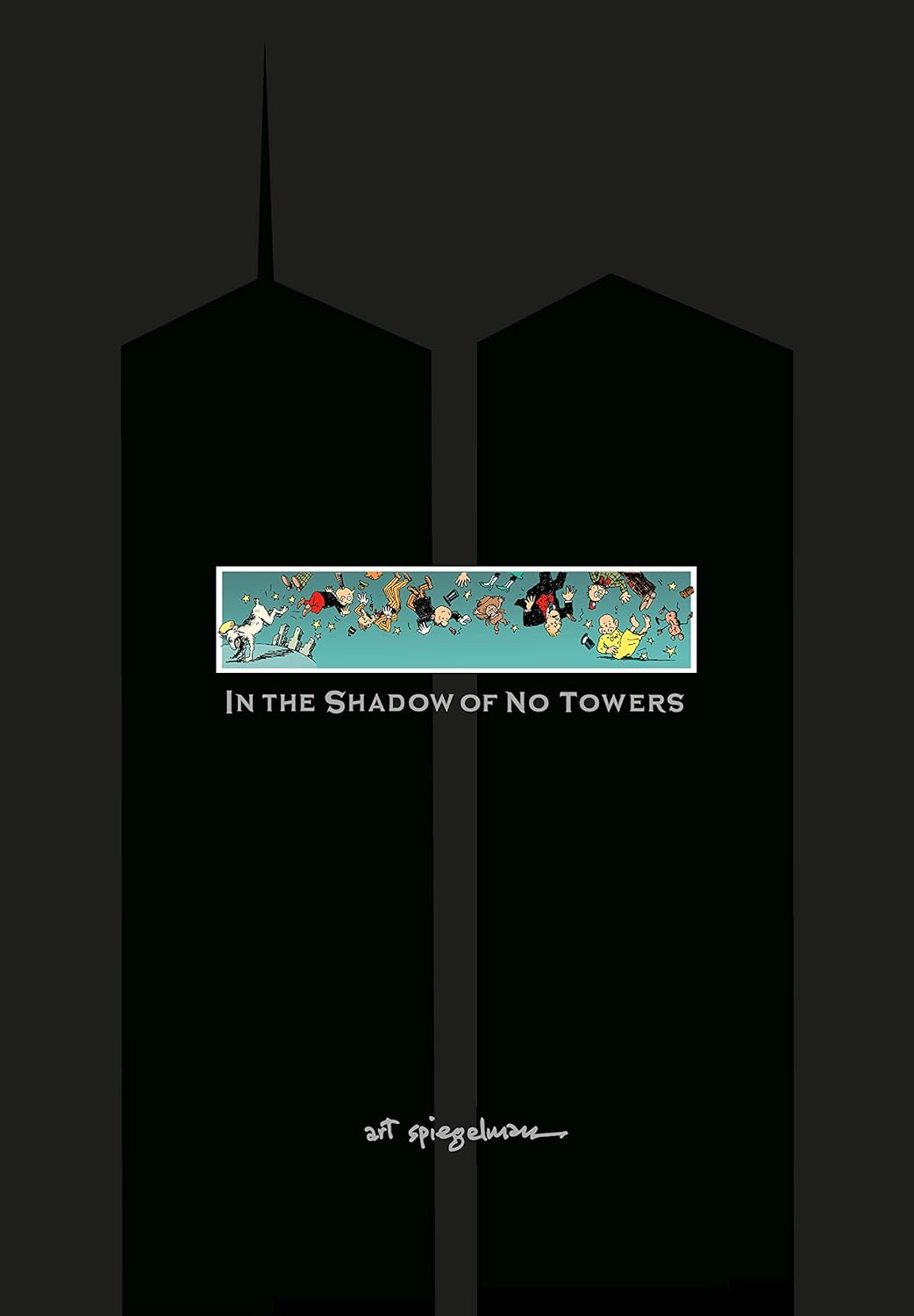

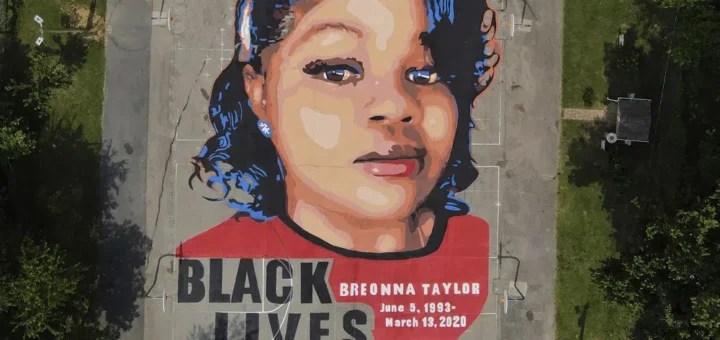
Read the full AP article here

John Newton, “Amazing Grace”, 1772
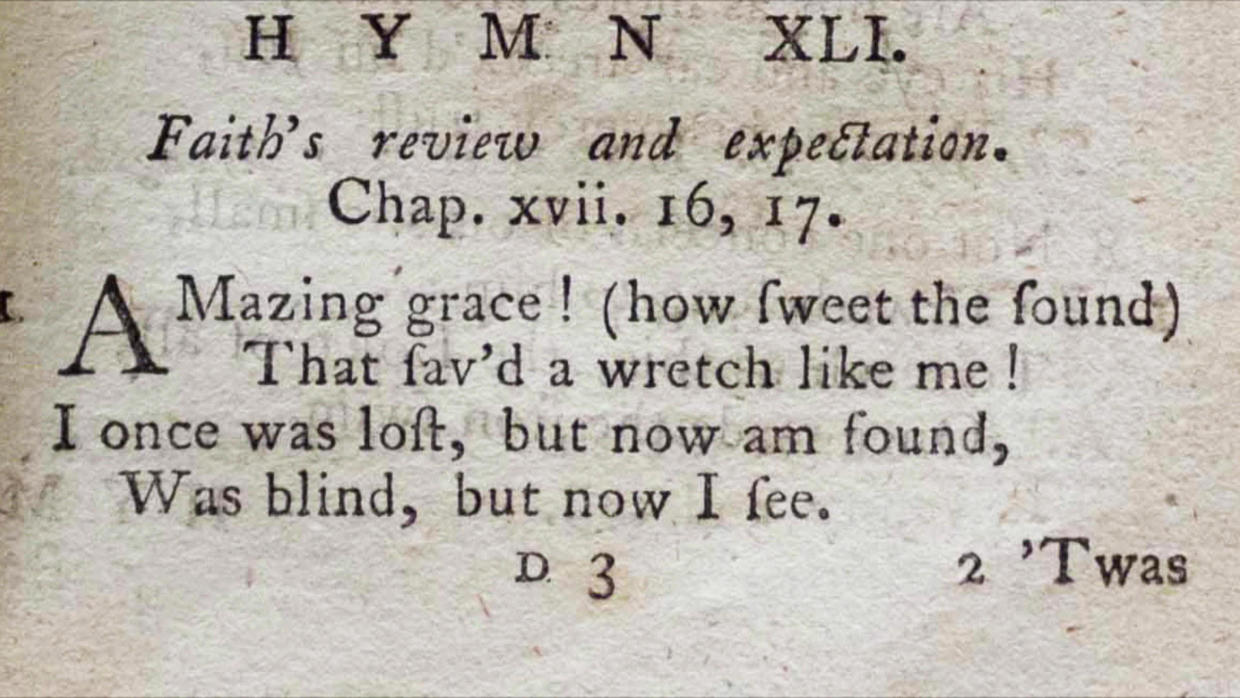
John Newton was slave ship master for several years, bringing enslaved Africans to England. In 1754, after becoming violently ill on a sea voyage, Newton abandoned his life as a slave trader, the slave trade, and seafaring, altogether, wholeheartedly devoting his life to God’s service.
In later years, Newton fought alongside William Wilberforce, leader of the parliamentary campaign to abolish the African Slave Trade. He described the horrors of the slave trade in a tract he wrote supporting the campaign and lived to see the British passage of the Slave Trade Act 1807.

The UB President, Satish K. Tripathi and the Editorial Board of the Buffalo News were wrong to defend the presence of Michael Knowles, the “intellectually bankrupt bombast” who speaks “noxious content” and “hateful and dehumanizing rhetoric” — their words, not mine — under the auspices of Free Speech.
They defended his right to a public platform via the apologia of the First Amendment to maintain democracy and to reject censorship. But both those lines of defense are weak.

Michael Knowles has been given multiple stages to speak. A public university should not be one of them. Because provocateurs, like Knowles, are not interested in discussion or debate. They tell lies as truths. They present opinion as fact. Knowles asserts that Trump’s election was stolen. He called the January 6th hearings “propaganda” and Greta Thunberg a “mentally ill Swedish child.” Knowles and his ilk have a Weltanschauung without the world.
The goal of such provocateurs is not to present differing or opposing ideas, but rather to build support for their absolutist and oppressive ideology. Their goal, a call to action. They know it. We know it.
To defend Knowles’ right to speak based solely on the legal parameters of Free Speech, which really speaks to the Supreme Court’s inability and unwillingness to define “Hate Speech”, smacks of cowardice.
We are living in dangerous times. Buffalo personally knows all too well what happens when hate speech is given a megaphone. We cannot give ignorance and hate a platform. And, if we do, we cannot deny responsibility for the consequences of such speech. Consequences that we know are inevitable.


Democracies thrive when and only when individuals and institutions defend and protect the rights of all individuals: to life, liberty, and the pursuit of happiness. Such rights include the power of self-definition — including transgendered peoples’ rights. Democracies thrive when individuals and institutions are not afraid to confront racism, sexism, heteronormative and conformist ideology. We cannot be afraid to “call a spade a spade”.
No space is a-political or a-contextual. History has taught has that neutrality does not exist. Zero is only a number. The President of UB and the Editors of the Buffalo News cannot hide behind the reductionist understanding and implementation of Free Speech. By doing so, they void their political standpoint of valuing “diversity, equity, inclusion and respect” and of “being a good citizen” to the Buffalo community. You cannot argue that you create a safe space and then invite a man like Knowles to speak. Owning a value without a lived practice is meaningless.
Both UB and the News need to do better. Martin Luther King, Jr. reminded us that everything the Nazi’s did was legal. We must make decisions that are morally and ethically right. Such as The University of St. Thomas. Their reason Knowles was never scheduled: he is disrespectful and lacks credibility. Well done, St. Thomas.


“PIONEERS FROM THE SETTLED, EASTERN UNITED STATES CAME TO THE PLAINS IN THE NINETEENTH CENTURY. BY 1876, THEY HAD PUSHED THE INDIANS INTO RESERVATIONS AND SLAUGHTERED MILLIONS OF BISON. RANCHERS AND CATTLE REPLACED THE INDIANS AND BUFFALO.”
According to the Equal Justice Initiative, the non-profit organization that provides advocacy, research and education on “communities that have been marginalized by poverty and discouraged by unequal treatment.”:
About 15 million Native American people were living in North America when Christopher Columbus arrived in 1492. The “Indian Wars” and massacres devastated the indigenous peoples. Fewer than 238,000 Native Americans remained by the end of the 19th Century.
Don Brown is an award winning author of historical non-fiction; of which this book is considered and; that is listed “for older readers”, students between ages of twelve to fifteen. I wonder as he was writing that paragraph, did he hesitate for a moment, to think about what words to use. Words to accurately capture the historical reality that the “settling” of the U.S. resulted in not the replacing of Indians and Bisons, but the genocide of Indigenous Peoples across the Americas.
Native older readers know the truth. White older should then be able to handle the truth. If we do not tell the truth of the U.S.’s brutal history, who then, are we protecting?


Roger Goodell had no right to be in Buffalo paying respects to the victims of the May 14th Massacre. He and the NFL played a major role in the rise of the radical Right’s anti-Black rhetoric and violence, with their hostile and contentious reaction to Colin Kaepernick, their divisive speech, and their distortion of what U.S. patriotism looks like. Imagine the U.S. today if Goodell embraced Colin’s message in 2016. His apology came four years later, after the murder of George Flyod. He bears responsibility.


Thank you President Biden for calling the May14th Massacre an act of “Domestic Terrorism”. We did not need thoughts or prayers. And yes, we are dealing with the “poison” of White supremacy. But, that threat has moved beyond an intellectual or ideological battle. We are in the middle of a low-intensity war being waged by the radical Right. Their weapons are anti-Black and Brown rhetoric, fear-mongering, and in again in this century, guns and bullets.
Conservative Parties and the Religious Right, which include many of the GOP leaders, are promoting and implementing racist, sexist and hateful ideologies: anti-immigration, anti-Critical Race Theory, anti-abortion, anti-Muslim, anti-LBGQTT, anti, anti, anti. Trump and his ilk enflame and create foot soldiers amped up into a frenzy from the likes of Kyle Rittenhouse — the Right’s golden-boy — to Payton Gendron; individuals who support that agenda and carry out violent, terrorist attacks.
This kid, old enough to buy guns and ammunition, but not alcohol or tobacco, was not a lone wolf. His actions (including intel and surveillance) are classic underground guerrilla tactics. Fast-paced, small scale violent attacks by individuals or groups, who work independently, yet in conjunction and support of a formal body politic. Moves the Radical right have been using for generations, and that have escalated since Trump’s presidency.
The killer is from the small town of Conklin, NY whose residents stated they were “shocked by it all”. Yet, many of those same residents shamelessly fly the Confederate Flag. That flag, created by slavers and traitors, cannot be separated from its racist history or its thinly veiled threat against people of color.
The Center and the Left need to realize that their public protests and demands for policy change are not working. History has shown that movements based on equal rights do not confront or defeat racism, bigotry, anti-semitism, and sexism: all major tenets of White Nationalism.
Government leaders need to challenge themselves and the growing Right radicalism within the Republican Party. News, entertainment, and social media outlets need to be held accountable for dissemination of hate speech and lies. Serious changes need to be made to our Senate representation. The Electoral College needs to be eliminated. We need to move away from the rhetoric of “rugged individualism” to the practice of “a collective good”.
The massacre on Saturday targeted Black Buffalo, traumatized Black and White Buffalo, and terrified our country. Support for White nationalism is growing. Violence from White nationalists is growing. A line is being drawn in the sand. It is time to seriously address the dangerous Right radicalism that is taking possession of the soul of our nation; the only soul we need be concerned with. Or else, we will not be great enough to avoid a second Civil War.


The debate as to whether or not University of Penn swimmer Lia Thomas, as a transgendered individual, should be allowed to swim on the women’s team is being framed as a Transgendered Rights issue. Lia commented, “I just want to show trans kids and younger trans athletes that they’re not alone…I am a woman, just like anybody else on the team.” Yes, she is a trans- woman. But, this is not a Trans Rights issue. This is a Woman’s Rights issue. It’s about privilege. It’s about sexism.
Thomas grew up as a white, heterosexual male. This is not to dismiss any pain she ever felt as a child or adolescent struggling with her identity. However, it cannot and should not be ignored or dismissed that as that boy she experienced advantages, privileges, and entitlement. The exact kind that Lia is acting out today. She’s claiming a right to a space — on the women’s swim team — without any consideration for how she is appropriating the space of a teammate. A team mate without the physical advantages of having gone through puberty as a male.
Ignoring disparity and unfair advantages or operating in a way as if they do not exist are emblematic behaviors of a privileged class.
Because she grew into early adulthood as boy, Lia did not experience the inherent cultural sexism that is part and parcel of being a female athlete. The sexualization of female bodies. The lack of parity in opportunities, training, and equipment. The difference in community and media response and support. Lia’s inability to see or acknowledge this historical context; how she’s personally benefiting from her position and; the lack of empathy or understanding she has for her teammates’s experiences is telling.
As a transgendered person, Lia has not been marginalized. She was given immediate and swift support from her Ivy League university, the NCAA, and her teammates. She has been given multiple platforms to tell her life story and defend her right to be on a women’s swim team. She has been treated with respect and dignity; her opponents defend her right to swim, not her right to be.
Lia Thomas, the University at Penn, and the NCAA are controlling the situation and narrative at the expense of all women athletes. In their misguided attempt to support Trans rights they have created an uneven playing field that, as Olympic swimmer Michael Phelps called it, is akin to doping. They have abandoned and silenced the other forty women on the team.
All three are doing what patriarchal and privileged systems do to undermine marginalized groups: they pit them against each other.
The University of Penn and the NCAA need to change their position. However, it’s Lia Thomas who should be embarrassed. Her actions are selfish and demanding. For her, it’s all about winning. And, now her eye is on Olympic gold. Let’s be clear, Lia Thomas is a woman. That’s a fact. But, let’s be also be honest; her white, male, privilege is definitely showing.


The inside of a Starbucks in NYC at the end of 2021.
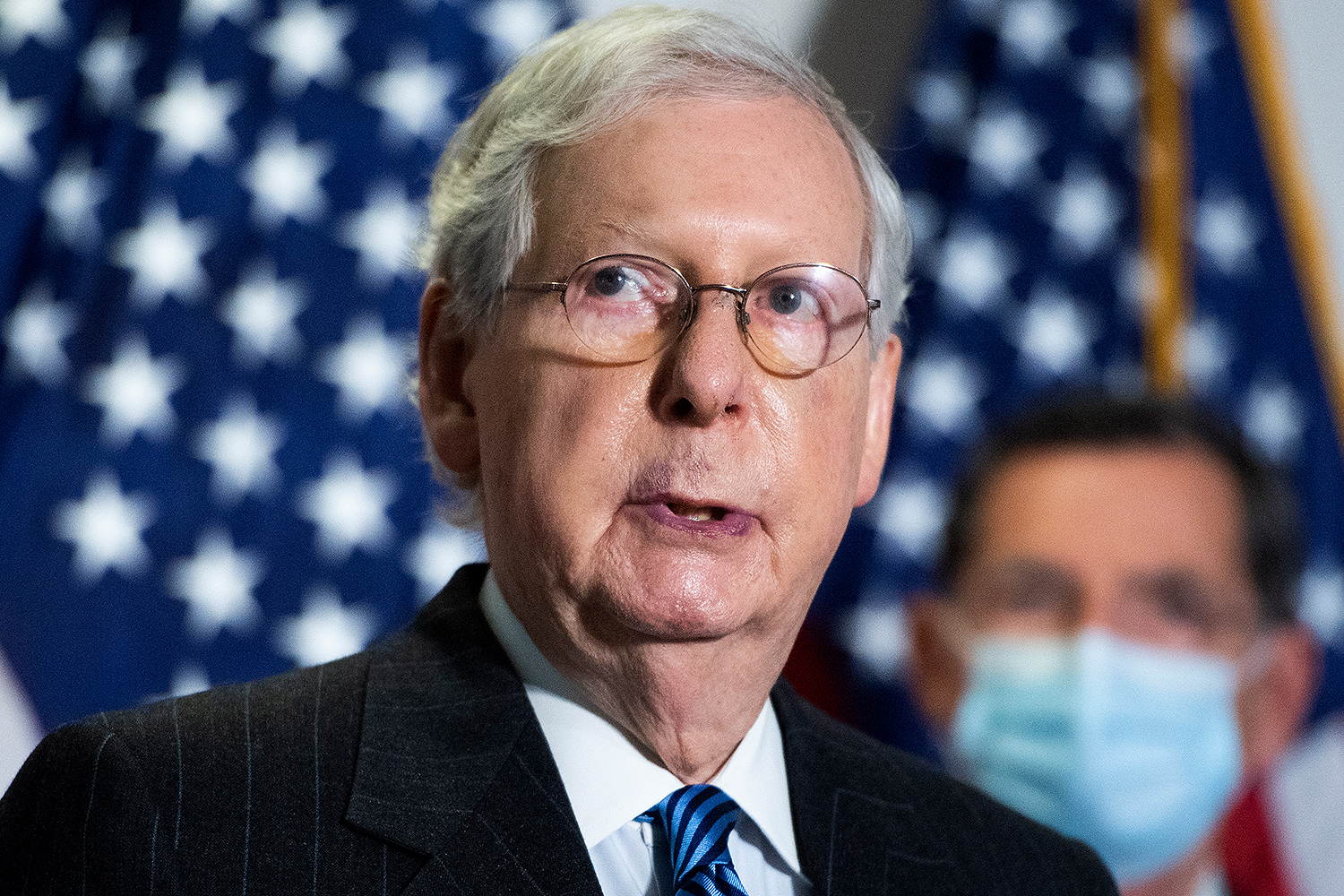
Senate Majority Leader Mitch McConnell, R-Ky. (Getty Images)

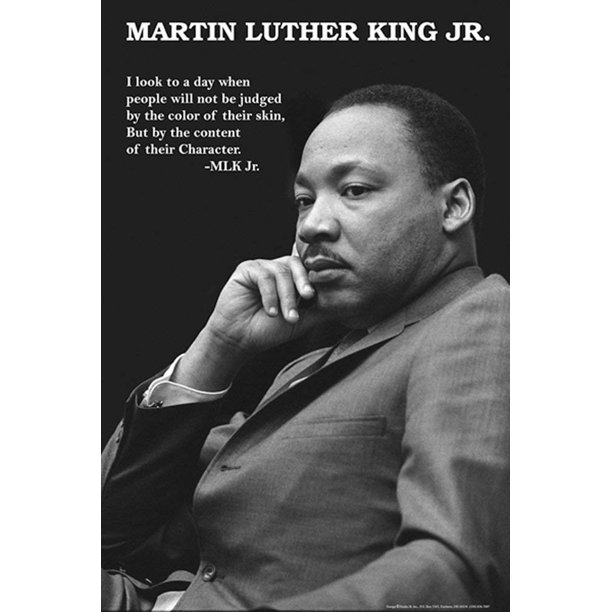
White Americans love to use the those words, a-contextualize them, and then use them to support their own agenda. As the Buffalo News wrote, “Using that [above] sentence, some conservatives quote King more often than they do Ronald Reagan, William F. Buckley or Barry Goldwater. They contend that King advocated for a color-blind society and would take offense at racial equity initiatives”. (1/17/22).
The News shared a statement made by Florida Governor, Ron DeSantis :
[School curriculum is] “basically teaching kids to hate our country and to hate each other based on race. It puts race as the most important thing. I want content of character to be the most important thing.”
Yet, the reality is that when it comes to White America and how they relate to Black America, judgment is put aside. Character does not matter.

Owen Diaz was a former elevator operator at Tesla, Elon Musk’s electric auto plant in Fremont, California. Years ago he sued the company, alleging racial discrimination, racial harassment, and a hostile work environment.
In 2018, The New York Times wrote an expose on Tesla, titled, Menial Tasks, Slurs and Swastikas: Many Black Workers at Tesla Say They Faced Racism. Diaz was interviewed for that piece.
“Owen Diaz had seen swastikas in the bathrooms at Tesla’s electric-car plant, and he had tried to ignore racist taunts around the factory. “You hear, ‘Hey, boy, come here,’ ‘N-i-g-g-e-r,’ you know, all this,” said Mr. Diaz, who is African-American. Then, a few hours into his shift running the elevators, he noticed a drawing on a bale of cardboard. It had an oversize mouth, big eyes and a bone stuck in the patch of hair scribbled over a long face, with “Booo” written underneath. ” (NY Times, 11/3/18).
In response to Mr. Diaz’s allegations, Elon Musk e-mailed all his employees. The e-mail, titled, “Doing the right thing” offers the following directive:
“In fairness, if someone is a jerk to you, but sincerely apologizes, it is important to be thick-skinned and accept that apology, [and] if you are part of a less represented group, you don’t get a free pass on being a jerk yourself.”
In October of 2021, the jury agreed with Mr. Diaz’s assertion that Tesla had created a hostile work environment. They ordered Tesla to pay him $137 million in punitive damages.
Two months later Time Magazine announced that Elon Musk was their 2021 “Person of the Year”. About Musk, the magazine’s editor-in-chief, Edward Felsenthal, said.
“For creating solutions to an existential crisis, for embodying the possibilities and the perils of the age of tech titans, for driving society’s most daring and disruptive transformations, Elon Musk is TIME’s 2021 Person of the Year,”
Elon Musk will never be judged by the color of his skin. Time Magazine certainly did not judge him by the content of his character. And, that is what is means to be White in America.


This is a picture of my mom on her honeymoon in 1956. At that time she and my father lived in Lackawanna, NY. Lackawanna was home to Bethlehem Steel, a branch of that famous plant in Scranton, PA.
My father took this picture of my mother about to enter a washroom at a roadside gas station in Florida. The signs read: “Ladies“, “Men“, and “Colored“. They were struck, horrified, and ashamed by what they witnessed in the Jim Crow South while traveling by automobile. This picture was a testament of proof, to them, that the South was truly segregated.
My mother was always embarrassed by this picture. By using that restroom she felt complicit. A kind of tacit and unspoken agreement of Jim Crow. She spoke of that moment as a dirty secret. Of how they attempted to negotiate their guilt by exaggerated (and yet honest) attempts of kindness to every African-American they encountered — bus boys, hotel maids, or passers-by. They went to the South. Witnessed horror. Then left. Never to return.
My parents were right to feel guilty.
Guilt is about responsibility. Guilt is about remorse. Not necessarily caused by one’s actions, but a moral and ethical response to a wrong.
The work, however, is about what one does with that guilt.
This is not a condemnation of my parents. This is about how for years and years the majority of White citizens knew that their Black and Brown fellow Americans were being brutalized and traumatized by state policy. State policy that was enforced and enacted upon not just by institutions, but by individuals. And, they did nothing. Their lives continued with out interruption.
That was, and still is, an aspect of White privilege. Some things never have to touch you. You can ignore them. Or, you can do nothing. Like my parents did, in Florida. Just a feeling of disgust. A story to tell with a shudder.
My parents complicity could be defended or explained away. Perhaps their personal interrelationships with people of color could exonerate them. They were good people. And yet, why did they, like most good White people, allow for Jim Crow to continue? And, why did it take Black and Brown people marching, rioting, and dying for things to finally change?
I once wrote: “The sky is blue. The grass is green. Black people suffer.” As if Black injustice is an a-priori of the United States.
Sixty-five years later Black and Brown people are still marching, and rioting, and dying. The Civil Rights movement was not a failure. But, as activist and scholar Dr. Henry Louis Taylor so succinctly and eloquently argues, “Blacks are still not free”. In 2021, White people are more outraged about the daily social injustices that Black and Brown people experience. The brutal and callous murder of George Floyd by police galvanized a whole bunch of White people. And yet, not enough White people. A big constant remains. The majority of White people remain indifferent or silent about taking concrete actions to becoming anti-racists. For whatever reason.
I am not speaking to the people who believe that racism no longer exists. Or those that believe that racism is about individual behavior and not ingrained in our institutions. I am speaking to those who know that racism is a problem, if not the problem, in our nation. Yet, still do nothing. For whatever reason.
We know that “Silence = Death”. Those iconic words were written and illustrated in 1987 by AIDS activists. But, they speak to a historical and universal truth about all oppression.
I keep this photo on my writing desk. It is a daily reminder that my guilt must result in more than a lament. It is my call to action. I cannot, nor should not, allow my Black and Brown brothers and sisters to continue to live in a country that is less inviting, more painful, and more damaging to them. I cannot not, nor should not, let my Black and Brown brothers and sisters do all the work. Because it is at their cost. Not mine. And. And. And, most importantly, it is not their task, nor their responsibility, or their obligation. It is mine. It belongs to me. It belongs to all White people.


I have been studying, writing, and teaching on the subject of Whiteness and systemic racism— Critical Race Theory — for almost twenty years. For the critics and detractors, let me share with you what I know and what I do. First and foremost, let me start with what Critical Race Theory (CRT) is not. It is not “White people bad” and “Black people good”. It is not about making the White kids feel personal shame or personal responsibility for all the injustices that Black and Brown people have suffered and continue to suffer. Never, in any classroom discussion is it argued that White people do not suffer. No one is saying that all White people are rich or that White people do not know extreme poverty. In fact, I try to avoid using the words “White privilege” and “White supremacy” because they are such loaded, hot-button terms, that often just shut down conversation.
CRT and Whiteness Studies argues that racism is not the consequence of the actions of individual racists, but that racism is embedded in the systems of our nation: legal, economic, education, religious, and political. These systems all purport the myth of equality, but operate in a way that has always benefited Whites and continues to do so. CRT challenges the national myth that everyone in our country is treated equally, has the same benefits and opportunities, and that the playing field is level. CRT examines how our institutions create and perpetuate racial inequities; how they are powerful, unequal, and self-sustaining.


CRT makes visible what is invisible. We examine the realities of unequal wages, unequal treatment in the legal system, and segregation in jobs, housing and education. We ask questions. Why are there a disproportionate number of Black and Brown people in prison for using and selling drugs when we know that more White people use illegal substances (proportionally) than any other group? Are low-income Black and Brown neighborhoods a natural occurring consequence of economics and real estate development? Why were domestic workers and farmers excluded from social security benefits? Why are Black and Brown people less likely to graduate from high school and college? Why do we allow immigrants from Mexico and other Latin American countries perform seasonal work in our fields and hotels, but deny them full citizenship? How is it that White Congressmen can argue that the January 6th riot and attack on Capital Hill was a “normal tourist day”?

Systemic racism is real. There is no “other side”. Teaching Critical Race Theory is about teaching history, presenting facts and statistics, and learning about the lived experiences of Black and Brown people. At best, it may cause discomfort, at worst, fear. But, teaching CRT isn’t about White guilt. It is about White responsibility.

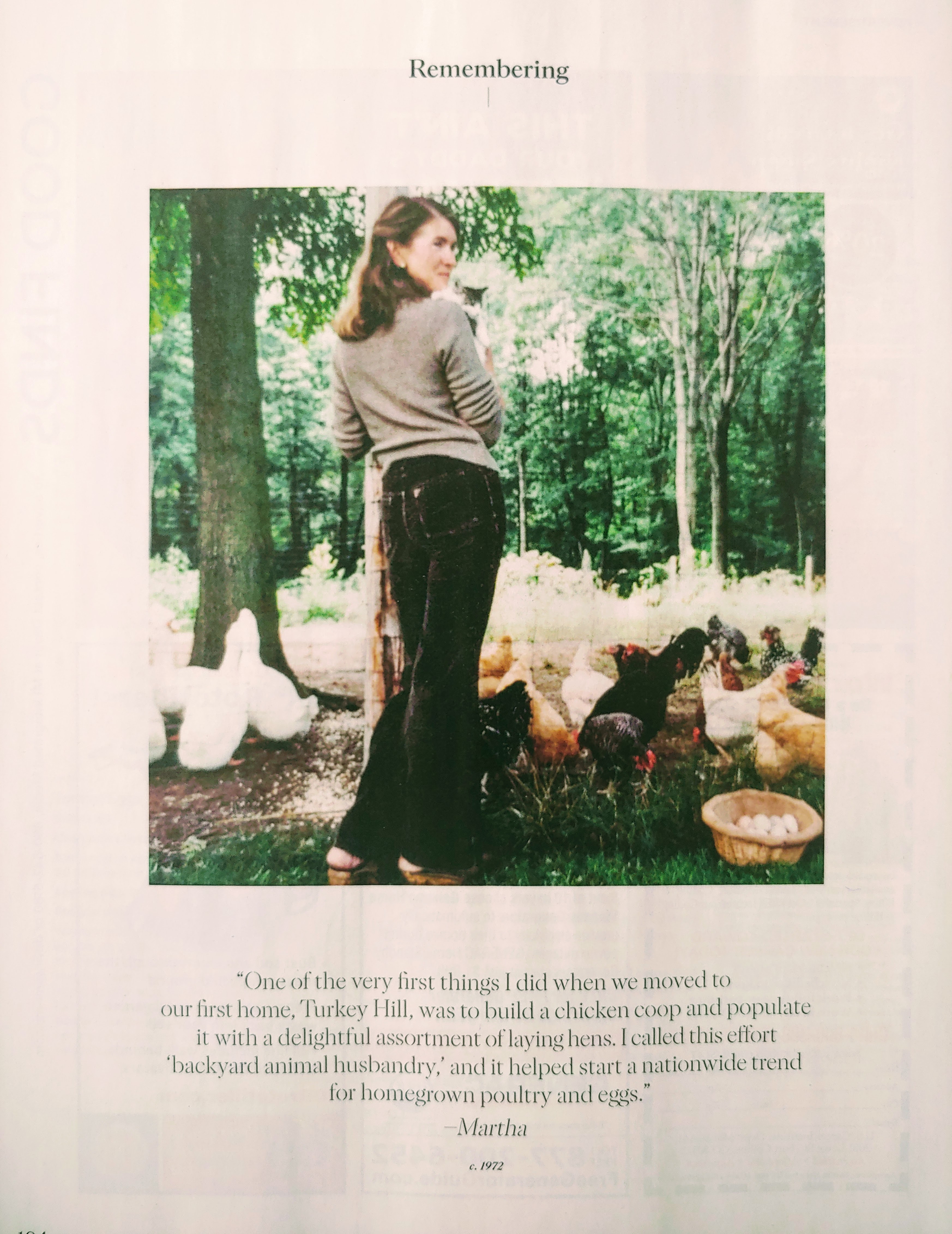
This was the last page of the April 2021 issue of Martha Stewart Living magazine.
Martha Stewart presents herself as an American icon of New England patrimony and good taste. Her eponymous omni-media corporation offers information and advice on all things food, holidays, cleaning and organizing, entertaining, garden, home, and wedding related.
Her conviction of insider stock trading and sentencing of five months in a federal prison did absolutely nothing to stain her lily-white credentials. In fact, she has been reported as saying, that, if anything, her time in prison gave her “street cred” with the African-American community.
In this Remembering photo moment, Martha Stewart is timelessly dressed in a (probably) cashmere sweater, wide-legged pants, Swedish clogs, and sporting (probably real) pearl earrings. It is her youthful face that reminds the viewer that this a picture of a younger Martha. She is captured standing outside of her pen of domestic chickens and geese. Landed gentry. (One cannot help but wonder if she was happy to leave her Polish maiden of “Kostyra” behind.)
Her reminiscence reads:
“One of the very first things I did when we moved to our first home, Turkey Hill, was to build a chicken coop and populate it with a delightful assortment of laying hens. I called this effort ‘backyard animal husbandry’ and it helped start a national trend for homegrown poultry and eggs”.
— Martha, c. 1972
When I first read this assertion, that in 1972 she started a “national trend for homegrown poultry and eggs”, I laughed and said to myself, “No you did not.”
In the mid-1960’s I grew up in Lackawanna, New York. The small house that my parents rented was in a working class, immigrant, neighborhood that sat right next to the Bethlehem Steel factory. Most of the neighborhood men worked there. Rainbow-hued, oil-slick puddles always followed a heavy rain. Many of our neighbors had chickens in their back yard. This was a “trend” that followed them from the “old-country”; born of culture, habit, and hunger.
I also noticed this “trend” when visiting a friend in Phoenix, AZ who has a house in a predominantly Mexican immigrant neighborhood. It is not uncommon to see chickens roaming in people’s yards or to hear roosters crowing. Again, a “trend” followed from home born of culture, habit, and hunger.

Martha Stewart presents to the world a mythical and imagined self that is a reflection of White privilege and White power. As a wealthy White woman she has the luxury of creating a narrative about her self, a narrative that often goes unchallenged, is celebrated, and to be desired.
Her anecdote of starting a “national trend for homegrown poultry and eggs” is a kind of cultural appropriation; a claiming of an experience that one did not have and one does not own. She is gentrifying what Black, Brown and the immigrant poor have done for centuries: feed their families by keeping chickens.
This self-aggrandizement by Martha Stewart is a reflection of the power that White people have in the U.S. to create a mythical self. To co-opt an idea or experience and repackage it and represent it as the original architect or author.
It is done with impunity. It is done without shame. It is done purposefully. It is done to maintain the myth of a superior White self.

I want to share a recent encounter I had with a White man outside of a post-office building that is forty-five minutes south of Buffalo. It is in a predominantly White working and middle class, rural community.
He was responding to this bumper sticker on my car.

What follows is our conversation, pretty much verbatim. WG = White Guy.
WG: “Can I ask you something?”
Me: “Yes.”
WG: “Don’t all lives matter?”
Me: “Of course.”
WG: “Then why the Black Lives Matter sticker?”
Me: “Because all lives won’t matter until Black lives matter.”
WG: “Have you ever been to the East Side? [He is referring to the East Side of Buffalo which is a predominantly African-American neighborhood.]
Me: “Yes. Have you?”
WG: “They’re killing each other.”
Me: “That’s not true.”
WG: “There’s a lot of Black-on-Black crime and they never talk about that.”
Me: “Well. In fact, many Black community leaders do address violence in their communities. But, how come you’re not talking about White-on White crime?”
WG: “What?”
Me: “I am more likely to be robbed, raped, or murdered by a White man and no one ever talks about White-on-White crime: in that way.”
WG: “What about the police?”
Me: “What about the police?”
WG: “Their lives matter too, you know.”
Me: [Holding my hand up] “Oh, please. Police lives have always mattered. And, no one group owns the police, the military, or the flag. I have family in the military and my father was a [NY] state trooper. So don’t talk to me about the police.”
Me: “The reality is that Black and Brown people in this country are not treated the same way as White people in this country.”
WG: [While walking away]. “Yeah. They’re treated better.”
I walked away, too.
The conversation was not hostile. Both of our tones were even tempered. However, I still found the conversation deeply disturbing.
The best way I can think of unpacking this experience is to write him a letter.
Dear Anti-Black Lives Matter (BLM) Guy,
Out of all the other bumper stickers on my car, why did the BLM one upset you the most?


I asked you if you’d ever been to the East Side. You didn’t answer. Is this because you’ve never been there and didn’t want to admit it? Where did you get the idea that Black people who live there are all killing each other? Was it from the the news? Everyone knows the local news stations perpetuate the lie that the East Side is rife with gangs and street violence. This is just not true.
I’ve worked in various neighborhoods in the East Side for decades. These past two summers I worked at a community garden located in The Fruit Belt. I even looked into buying a house there. The blog site “Buffalo Rising” wrote an article about it:
I’ve never not felt safe when I worked in the East Side. It’s more about me being comfortable with not having so many people who look like me, i.e. White, around. However, as a woman, I know that I have to be careful. I’m more likely to be assaulted on my college campus than I am anywhere else. I wonder, does that make you angry?
I also want to ask you why you think you can comment on what Black community leaders address when it was clear you don’t know? If I were to ask you to name just one local Black community organization, could you? Can you name one Black community leader?
Also, you seemed confused when I mentioned “White-on-White” crime. Why was that? White people commit crimes all the time. White men commit a lot of crimes. Some crimes get reported more than others. Some crimes are seen as worse than others. We need to look at the social, political, and economic reasons of why people commit crimes. This is not the place for such an argument. All I can say right now is that White people are not held to a group standard of behavior. We have the luxury of being seen as individuals, not as a reflection of the whole.
You mentioned the police. You asked me if their lives mattered. You and I both know that police lives have always mattered. Americans have always honored and celebrated our police and military forces. They are present in our local and national parades and at our local and professional sporting events. U.S. citizens donate millions and millions of dollars to police charities every year. And, harming a police officer carries a more severe punishment than harming anybody else.
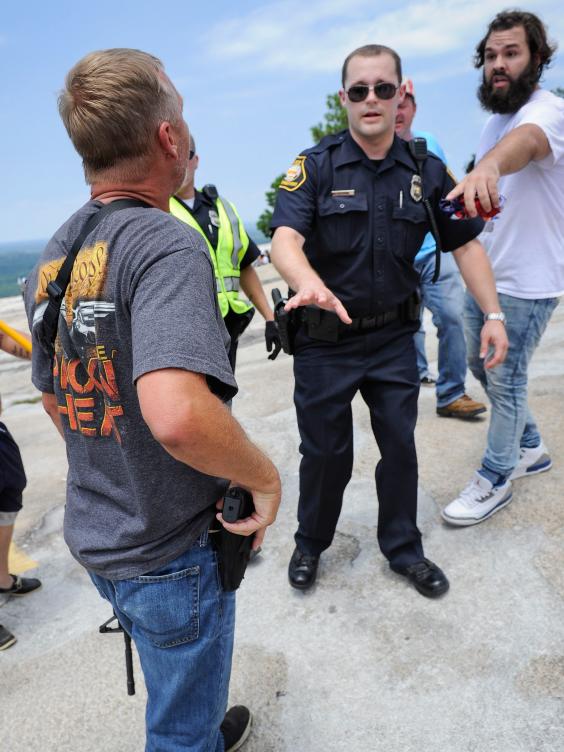
The BLM movement exposes a very serious problem in our police culture. That is the unequal treatment that Black and Brown individuals and communities experience at the hands of our police. This is a proven fact. We need look no further than the recent attack at the White House and the Capital Police’s response. The people who stormed The White House were not protesters, they were insurrectionists. Yet, unlike at the BLM protests throughout our country these past few years, the police presence at the Capital Mall was small. Most importantly, the Capital Police denied assistance that was offered by the Pentagon and the F.B.I.. Most Americans expected violence from Trump supporters. Why didn’t the police? We all know that had those agitators been people of color the police would’ve been out there in large numbers, wearing riot gear, carrying military weapons, and using full force.

Lastly, I ask you, in all seriousness, why do you think Black and Brown people in the United States are treated better than White people? Where did you possibly get that idea? How do you not see that it is easier to be a White person in this country than it is to be Black or Brown person? It was so obvious to me that you do not really know any Black or Brown people. I am not talking about acquaintances. I am talking about having a friend who is of color. Who you break bread with, laugh with, cry with, or celebrate life’s milestones. You know what I mean. Because if you did, you would know about their experiences; the daily injustices they have to endure; the pain of living in a world that is less welcoming, less inviting.
I think what scares me the most about our conversation is that you’re not alone in your beliefs.
“Thirty to forty percent of Americans believe they have experienced prejudice and/or racism based on being White.”
FYI: There is no such thing as reverse racism. I know you won’t believe me just because I say so, but it’s true. This is why I write what I write. To help White people examine the world through a critical white lens. I am going to put together a reading list. Because you, and every other White person who thinks like you, really need to do their homework. Because you all got it all so wrong.


Syndicated columnist Marc Thiessen from The Washington Post Writers Group wrote an opinion piece about America’s greatness. He uses his mother’s history as a Polish resistance fighter during W.W. II and then U.S. refugee to ground his analysis.
I find Thiessen’s commentary on America’s greatness deeply problematic. He conflates American mythology with American history, thus hiding our nation’s ugly past. The fact that he cannot distinguish fable from fact is at the very core of what is wrong with our country. The fiction of America’s origin story becomes more important than its truth.
Thiessen writes:
“America’s greatness lies in the fact that it is the only country in human history built not on blood or soil but on an idea — the idea of human liberty.”
This statement is arguable and demands critique. The founding fathers defined “humanity” in racial terms. Whites were “human” and people of color were not. This denial of Black, Brown, and Indigenous humanity is the original sin of our nation. The United States was founded in the contextual realities of slaveholding and frontier settlement.
We must ask: “Whose Blood?”

The Declaration of Independence was racialized as rights were only given to free White males. Whites were legally given the “right” to trample on the freedoms and liberty of non-Whites. The wealth of this country was created by the millions of enslaved Black bodies who made cotton king and the industrial north prosper.
We must ask: “Whose Soil?”
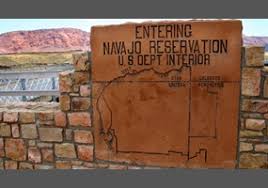
At the same time, the US waged war against Indigenous peoples. The 1830 Indian Removal Act gave states permission to steal native land and forced the natives onto reservations. Conditions on those reservations led to disease, hunger, and death; what the United Nations today defines as genocide
Death, destruction, and disease in the interest of power and and profits are what built our nation. We cannot substitute mythology for history. Nor should we create an ideology that romanticizes and erases the brutality of that history. Because that history created a legacy that shapes the political, economic, and social realities of life in the United States today that effects all of us.
When Americans create and accept a mythologized history separated from reality, we do so at our own peril. How can we solve the problems of racism, sexism, misogyny, and police violence if we hide beneath the mask of greatness? As if all lives during our nation’s inception were valued and free? If we separate an idea from its context, reality, or practice we create a falsehood. The application and practice of the idea is what is real; it is what matters. It is what makes the ideal absolute. If we don’t face our shadowy past, and see how that past shapes our present, how then can we create a future that has a lived practice of human liberty for every citizen?
Is it any wonder then, that we have a citizenry who is more outraged by those who “disrespect” the symbol of “liberty and justice for all”, the American flag, then they are by the fact that liberty and justice for all does not factually exist in this country. The symbol of our nation is more important than people of our nation. The myth is more important than the truth.
In this year alone, the police used fatal force to kill 1,020 citizens (White, Black, and Brown). Three hundred of those citizens were under the age of 19.


In a previous blog I wrote about Whiteface, which I defined as the process of removing innate or natural facial characteristics (skin color; nose, lip, and eye shape; hair color and texture) to change the appearance of a person who is not-White, to make that person look as if they have Western-European ancestry.
In the United States, the standards of beauty have alway been defined by White Western-European standards. This is not to say that the notion or a creation of a uniquely “American look”, i.e. from the U.S., does not exist. Of course it does. But, the foundation on which the “wholesome and healthy American beauty” sits, comes from White Europe.


Standards of beauty in Western-European culture were defined by the groups with economic and political power. Thus, standards of beauty always stood in juxtaposition to those without power. Those who decided the norms and standards of beauty were those who lived the life of luxury; a life that was contrasted against the life of the serf, the peasant, the laborer, and the worker.
In aristocratic and oligarchic European nations, royal and noble women wore clothes that separated them from their subjects: they donned dresses, sleeves, and footwear that were neither practical, nor utilitarian. Those who visited the courts of kings and queens were able to see what was being worn by the sovereign classes and then copied those styles.
Without print and the ability to mass produce images, beauty was defined not so much by the physical attributes of a person, but by their born privilege to wear such clothing. The materials used during those times were extremely luxurious and expensive: velvet, brocade, and silk. The cost of those materials were prohibitive, and at times, illegal for the lowly or servile to wear or even own.


During Imperialism, beauty standards were still set by by the aristocracy. Beauty was still defined by the privilege to live a luxurious life. However, global travel and the imperial acquisition of goods created a new class. Wealth and power were no longer solely in the hands of the titled class, but also those of the merchant class. And, more importantly, it was during Imperialism and Colonialism that beauty standards began to be determined by physical characteristics. White skin was beheld.
In Europe and the United States, during the Enlightenment until the late 19th Century, the idealized body type for women was determined by her stature and girth. A woman with a full-body was admired because it epitomized an “idle” life; the patrician female spent her day weaving, painting, or playing the pianoforte. Her rounded and shapely body attested to cupboards and galleys that were well stocked. Her skin was lily white because she need not be working in the fields.


During Imperialism and Colonialism, White women began to travel outside of Europe for personal and political reasons: to engage in missionary work, to satisfy a curiosity about “exotic” lands”, or to write and explore. At the same time, the suffragette movement was growing. Women were demanding the right to vote, to own property, and to obtain individual wealth. These women were entering the physical spaces dominated by men. By doing so, they were seen as unwomanly and accused of being “masculine”.


Respectable White womanhood was no longer determined by domestic or political space. Geographical containment was no longer. How then, could the suffragette desiring the right to work and vote or the adventurous White woman traveler retain her respectability?
Suffragettes resolved this “insult” by presenting a fashionable, feminine image when appearing in public. They wore purple for loyalty and dignity, white for purity, and green for hope. London shops sold tri-color striped ribbon for hats, rosettes, badges and belts. English suffragette movement founder Emmeline Pankhurst took note. She worried that:
“Many suffragists spend more money on clothes than they can comfortably afford.”
The woman traveler and explorer retained her modesty and honor by working alongside respectable men. And, more importantly, by her body being juxtaposed next to the “inferior, uncivilized, colonized” woman of color.
In the 19th and 20th Century, numerous images of Black and Brown bare-breasted or totally nude woman were taken, constructed, and reproduced. The production of these images fathered the modern day studies of anthropology, criminology, and mental illness. (What was the “mug-shot” if not the successor of the ethnographic study?) These images sexualized Black and Brown women and were used to entice European and American men to travel and live within the colonies.


World fairs of that time contained “ethnological” expositions of African, East Indian, American Indian, and Latin American cultures and societies. These “human zoos” often emphasized the physical and cultural differences between Europeans of Western Civilization and non-European peoples: i.e., those who lived a lifestyle deemed primitive. The epitome of this exploitation is probably Sarah Baartman, a South African Khoikhoi woman who, due to the European objectification of her buttocks, was exhibited as a”freak show”attraction in 19th-century Europe under the name of the “Hottentot Venus”.
Against the ever-present backdrop of the “native” Black or Brown woman, who was continuously physically demeaned, immorally characterized, and sexually debased, White women were seen as beautiful, modest, and desirable.
As the modern woman’s life was no longer relegated to the parlor, a plump body was no longer fashionable. Once she entered spaces dominated by men and it became acceptable to travel, work, and even exercise, her body then reflected that lifestyle. A robust, strong, and healthy body became desirable, and thus the definition of beauty.
Present day beauty standards are still defined by those with political, economic, and cultural power. They are people who live the life of luxury, whether they are New York City socialites, Washington political powerhouses, or Hollywood celebrities. And, nothing exemplifies luxury like leisure travel. For White women today, that leisurely lifestyle is defined by the ability to vacation at the beach. However, the only proof needed: a beautiful sun-tan.

Tanning is associated with wealth, luxury, and leisure.
But, White women tan for another reason. On white skin, a tan creates the illusion of a slimmer body. Tanned skin makes white skin stand out. It gives white skin a fresh glow. And, it shows body contours and muscle definition.
White women tanning are not rejecting a White racial identity. White women tanning are not trying to culturally appropriate Blackness or Brownness. They are not trying to be seen as being Black or Brown. Instead, they are attempting to enhance their White cultural capital by being perceived as a member of America’s ruling class: the woman who has the time and money to relax, exercise and, spend time in the sun.


…and now, even more so.
(See Previous Post: Black Lives Matter Poem)

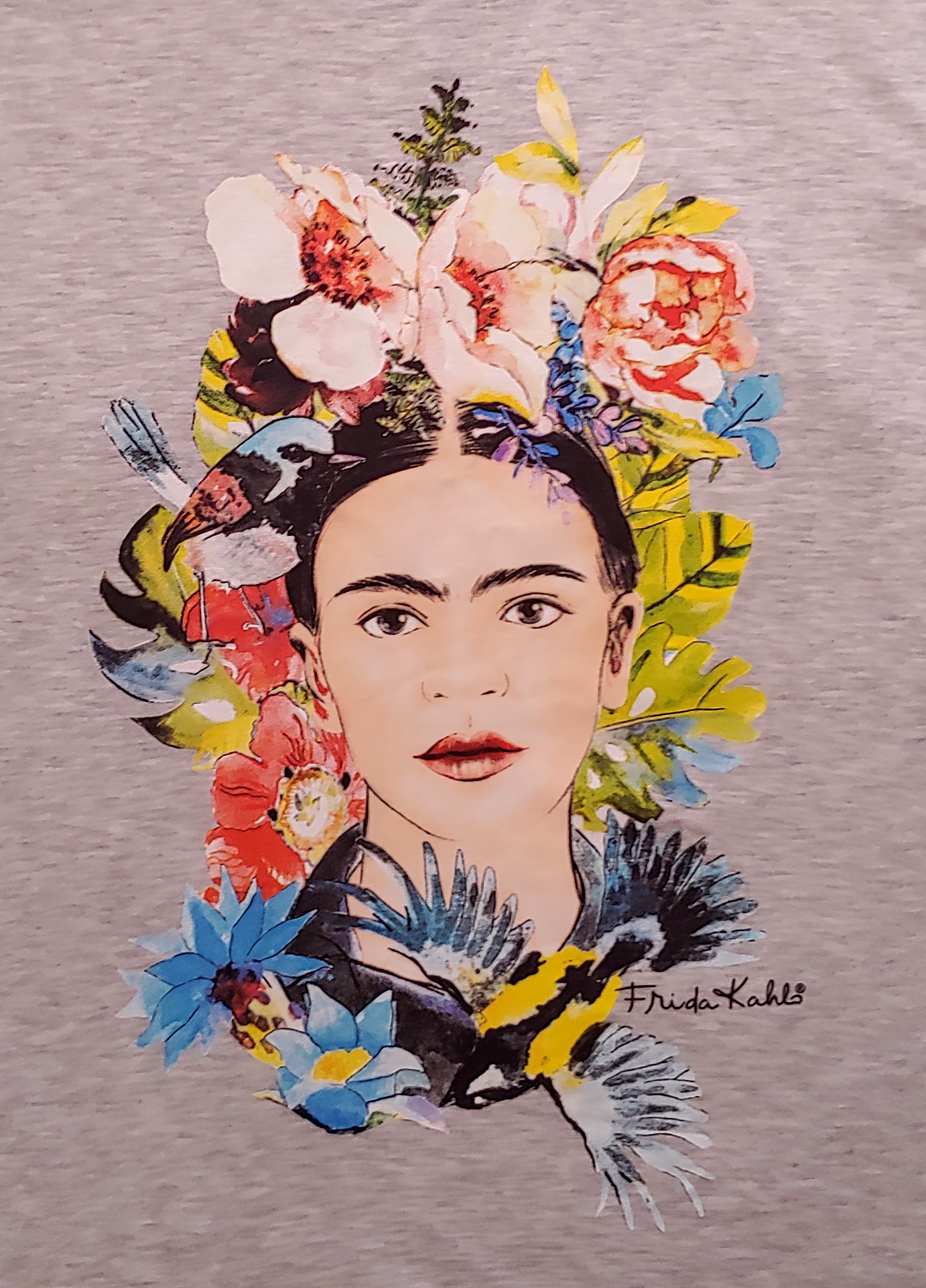
This is an image on a t-shirt I purchased at a Walmart store. It is supposed to be a picture of Frida Kahlo.
Born Magdalena Carmen Frida Kahlo y Calderón in 1907 to a German Father and a Mexican mother, Kahlo was a Mexican painter known for her surreal and biographical self-portraits, her intense and tumultuous marriage to Mexican artist Diego Rivera, her contribution to the creation of a Mexicanidad nationalism, and her active role in the Mexican Communist Party. In 1954, on July 12th, ten days after she demonstrated in Mexico City against the U.S. invasion of Guatemala, Frida Kahlo died.
Kahlo has attracted modern and popular interest to the extent that the term Fridamania has been coined to describe the phenomenon. She is considered one of the most instantly recognizable artists. Her face is re-created with the same regularity as the images of Che Guevara and Mona Lisa. Her life and art have inspired a variety of merchandise, and her distinctive look has been appropriated by the fashion world and Hollywood.
What is most reprehensible about this t-shirt, is not the commercialization of her image.* Rather it is the gross negligence that is done to her — making her look White, or as I call it: Whiteface.
Will the real Frida Kahlo please stand up?


Whiteface (my def): the process of removing innate or natural facial characteristics: skin color; nose, lip, and eye shape; and/or hair color and texture, to change the appearance of a person who is not-White to make that person look as if they have Western European ancestry. The purpose of Whiteface is to make that person more desirable and palatable to a White viewer or market. The value of Whiteface is being perceived as being White.
Whiteface is not is opposition to Blackface. Whiteface is dependent upon Blackface.
Blackface (def). is the displaying of a caricature of Blackness or of being Black using racial stereotypes that diminish, demean, and devalue their humanity for the enjoyment of white viewers.
Historical Examples of Blackface:


In 1926, the NAACP’s Crisis Magazine launched a symposium called “The Negro in Art: How Shall He Be Portrayed?” As editor of the magazine, W.E.B. DuBois’ primary concern was the representation of Black Americans. DuBois had reason to be concerned. Historical memory was being constructed, documented and preserved by images of enslavement and colonial conquest.
These past constructions of racial identities continue to control modern constructions of racial identities.
Modern Day Examples of Blackface:


Whiteface is dependent on Blackface because Whiteness does not exist without Blackness. White features and White bodies have been juxtaposed against Black features and Black bodies since the founding of this nation. Whether in the name of science via anthropological studies or the displaying of Black bodies in cages at world fairs. What has always been consistent is that because there is nothing biological about Whiteness, it ends up being defined in contrast to Blackness. Whiteness and Blackness are defined and thus perceived as contrasts, and more importantly, as difference.
Relationships of difference are dichotomous, either/or categorizations, in which terms gain meaning only in relation to one and at the exclusion of one another. Difference is often defined in uneven, hierarchical, and oppositional terms with the first being being seen as superior to the second: White/Black; male/female; culture/nature; fact/fiction. Race theorist bell hooks argues that such thinking is the “central ideological component of all systems of domination in Western society.”
Historically, Whiteface can be understood as “racial passing”.
Racial passing occurs when a person classified as a member of one racial group is accepted or “passes” as a member of another racial group. The purpose of racial passing is to gain access to that group’s political, social, religious, cultural or economic power. During enslavement and Jim Crow, racial passing often occurred when a person of color presented themselves as White to escape the legal and social conventions of racial violence, segregation and discrimination.
Passing in the 21st Century is controversial. It is often seen as a rejection of one’s racial identity, culture, history, and/or family. However, modern-day Whiteface is a different animal.
Whiteface is not about rejecting a racial identity. Whiteface is about erasing parts of a racial identity in order to be seen as more desirable, more attractive, and more accepting to a White viewer, audience, or market. Some famous examples include: Michael Jackson, Jennifer Lopez, Sammy Sosa, Lil Kim and Nicki Minaj.


The desire to Whiteface is not just a phenomenon of Hollywood. The desire to be seen as White or close to being White is a way of being marketable and being desirable. Colonial history is a present day experience. Dissociating, assimilating, etc., allow for Black and Brown people to enter into public and private spaces that are not welcoming. Social and economic mobility are dependent upon one’s appearance. What is considered professional dress, hair, and clothing are not impartial or natural. Professional dress, hair, and clothing are defined by corporate, capitalist, and White-Western European standards.
“It’s all for African Americans to fit into the workplace. Today, an African American trying to get a job is faced with the dilemma of do I straighten my hair for the interview to get the job? Why is my natural hair not considered professional?”
Wisconsin state Rep. LaKeshia Myers
The desire to Whiteface created a market for products that erase one’s natural or biological physical characteristics. Products and procedures which are still popular in the 21st Century include hair straighteners, skin-bleaching creams, and cosmetic dentistry to “repair” the natural gap between two front teeth.
The danger of Whiteface is that it is the mirrored and yet, oppositional reflection of Blackface. Blackface is Whiteface’s shadow. Blackface created the myth that Black bodies/African-Americans are not intelligent or civilized, and thus undesirable and even dangerous. It is a historical fiction that still carries weight. Whiteface sits on that history. Whiteface relies on that history. Whiteface duplicates that historically constructed message.
The power of Whiteface is real. This is not just about an aesthetic. There are economic, political, social, and cultural benefits to looking White or close to White. Would Obama Barack have won the presidency had he been a dark-skinned Black man sporting an Afro and wearing a dashiki? That is not a statement that questions Obama’s Blackness. It is a statement of what kind of Blackness White-America accepts.
Which leads me back to the alleged Frida Kahlo t-shirt. Kahlo was a Mexican, a Marxist, a revolutionary, and an artist. To separate her image from her politics is what capitalist and corporate White-America does best: ignore history and reduce revolutionary images into products to sell. Ultimately, diminishing, and minimizing any revolution.
What is most offensive about this t-shirt is that instead of celebrating Frida Kahlo’s signature looks: her fierce hair part; her uni-eyebrow, and her square jaw; they eliminated those exact same features. They made her look White. Whiteface.
* I will leave it to Kahlo’s biographers to determine if her Marxist ideology would leave her disgusted by the creation of the Frida Kahlo Corporation which owns the trademark rights to her name to make profits or; if her desire for artistic and critical acclaim would leave her amused by all the attention.


My kid got this book, Dads are the Original Hipsters, for his dad for Father’s Day this past June. The description from Amazon reads: “This book celebrates dads as the original hipsters. Vintage photos of real dads back in the day—in their short shorts and tight tees playing arcade games—accompany snarky captions that at once tip a cap to Dad’s glory days and poke fun at modern hipsters!”
It doesn’t take more than a cursory glance for the reader to realize that not one dad photographed in the book is Black or Brown. My first thought was “Doesn’t the author have any Black friends?”
The reality is much more complicated and complicit than a white guy not having any non-white friends. This book speaks to the larger problem of Black and Brown representation in our cultural images; and more importantly Black and Brown representations of manhood and fatherhood that reflect the real lived experience of those men. Men who love, who are caregivers, who are kind, who are warm, who are breadwinners, who laugh, who are silly, who are creative, and who are cool. (Images of Barack Obama not withstanding.)
I have written before about the lack of Black and Brown representation in political, cultural, and social images. And, how important it is to see oneself reflected in all spaces, locations, and sites. But, this book speaks to another problem: the invisibility and hyper-visibility of whiteness.
The white male figure is the imagined and normalized image that is so reflected everywhere, that we do not even see a white man as being white. He is just a man. The dentist. The teacher. The doctor. The president. The CEO. And, now, the hipster. (I will get to cultural appropriation later.) We only notice whiteness when it is juxtaposed against non-whiteness. Or, when our expectations are not met; when we as white people assume that our dentists, teachers, doctors, politicians, CEO’s will be white and they are not. White people expect white men to occupy positions of authority, power, and wealth. White people are not surprised if their janitors, garbageman, hospital transporters, or dishwashers are Black or Brown.
The lack of an imagined or real representation of Blackness or Brownness creates a cultural climate where whiteness carries normalcy, but never stigma.
The invisibly and hyper-visibility of a white man is the benefit which allows white men to be seen and not seen, all to their benefit. We expect them to be role models. We don’t expect them to be criminals. And, if they are, their pathology is blamed on individual psychology and behavior, rather than on their race.
Dads are the Original Hipsters may seem harmless. But, I am reminded of an experience of a recent graduate student. While taking a required course for a Master of Urban Planning degree, the student quoted the professor (and chair of the department) as saying that “Black children are perpetually impoverished because:
“There are no role models in urban Black communities”.
The professor went on to present the now debunked and disrespected “Culture of Poverty Theory” which blames black matriarchy, single-motherhood, the expansion of welfare programs and ghetto culture as the causes of poverty in Black families.* Let’s repeat that: “There are no role models in urban Black communities.” I asked my student to respond. He wrote:
“My reaction to it was shock because I could not believe a white Ph.D. told such a blatant lie to a group of majority white and international students. I immediately began to think about all the role models I had growing up. My uncles, my father, my mother, my sister and many others who got up every day and worked their asses off in order to provide for their families. I wasn’t sad or hurt by his comments, but angry because how dare he tell me, a Black student [and man] who grew up in an urban Black community, tell me, I did not have role models, as I sat and learned side-by-side with my white peers in the SAME classroom?”
He continued:
“I hate the stigma attached to Black fathers. I know for me, as a soon to be Black father, I see other Black fathers my age who are AMAZING fathers. We are abundant; we are not few and far between. We are present, we care about our families, we take care of our children AND our significant others. And, to be a bit snarky, the next time I hear about absent Black fathers, I will bring up abusive, alcoholic white fathers. I wonder why there aren’t any columns about that.”
*This student’s experience was validated by several other students in the class.
He is dead-on about the columns. In a July 2020 “Letter to the Editor” in the Buffalo News, a reader wrote what he believed to be a cause of Black underachievement in education and economics; “One obvious factor that persists is 73% of Black children are born out of wedlock.” He continues to complain about the “many men” out there “with multiple children with different women” in his “community work” who are not held financially responsible. This is ignorant and frightening; that a social worker is unaware of the effects of the history of enslavement and Jim Crow and how structural racism and purposeful underdevelopment in Black and Brown communities are the causes of poverty. Or, that being married does not make a man a good father or a responsible father.
These moments and experiences speak to the racist stereotypes and images that are reflected in the white world and in the white mind set. This is why I find the book, Dads are the Original Hipsters, so unsettling. It is a metaphor of sorts, of the assumed absenteeism of the good, Black or Brown dad…
…all while co-opting the definition of coolness that was defined by Black culture. The cover photo has a white dad carrying a boombox, or as the author calls it, “a portable music player.” Huh? The boombox was a status piece in Black and Latinx communities in the mid-1980’s and it quickly became associated with hip-hop and break dancing. The wide use of boomboxes in urban communities led it to being coined the “ghetto blaster”.

There is no single concept of what is cool or hip, but the existence of those expressions comes from Black culture and white-counter culture. Now, part of the mainstream, as this book attests, being cool and hip was a form of expression that was not constrained by western, white, elite, cultural and/or capitalist norms. It was a way of deciding for oneself what is one’s worth.
The author’s blindness to what were originally Black and Brown Black sites of coolness are numerous throughout the book. “DJing”, “Barbecue”, “Hanging Out on Rooftops”, “Nonconformist”, “Not smiling”, “Working Shitty Jobs”, “Drinking Cheap Beer”, “Protesting”, “Big Headphones” and “Tube-Socks” to name a few.
The lack of a political, historical, and social consciousness allows for the white-washing or making invisible the presence and value of Blackness and Brownness. Books likes these are not harmless. They re-write history. They call for a celebration of a whiteness that is not real. They are exclusionary.
How did the writer, the editor, the publisher not see this? Why is this okay?
So, again, I ask? Who is the writer? Who is the reader? Why are they always assumed to be white?
Therefore, in the interest of offering a corrective and counter narrative, I offer this picture, given to me by my colleague and friend. It is of activist, scholar, and writer: Dr. Henry-Louis Taylor with his first son. Taken around 1965. One cool dad.

My previous post, “Being An Anti-Racist White”, was published in the Buffalo News editorial page. Shortly after its publication, I received an e-mail from a reader asking me, very politely, to explain my position. I responded. What follows are excerpts from our e-mail exchanges. His words are in italics and in red. My words are in blue.
“I read your column in the Buffalo News, today. I think you make some good points, and some things which I do not think are good. Rather than examine every single point, please allow me to ask about two of them.
As a student of history, I was unaware that “the Irish, Italians, and Jews sued to be classified as white to gain “cachet.” Can you document that? Who was sued? Was it a class action including all three ethnicities or separate suits? When did this happen?”
Start with the Declaration of Independence which was racialized as rights were given to free white males — white men who were indentured were not allowed to vote, own property, participate in commerce, and many other activities within a community. The declaration was written in the contextual realities of slaveholding and frontier settlement.
The first census in 1790 recognized six categories within the population: 1) the head of each household; 2) free white males over sixteen; 3) free white males under sixteen; 4) free white females; 5) all other free persons by sex and color and; 6) slaves. The only race mentioned was white.
The word white and being white attained usage in the political discourse and bodies of law. A standard political refrain and concern in the 18th Century became the question of whiteness. Benjamin Franklin lamented, “The number of purely white people in the world is proportionally very small…I wish I could increase their numbers.”
Free white men had political, economic, and cultural power. Throughout the 18th and 19th century, the question then became “Who is white?” As Irish immigrated to this country they were denied citizenship rights and were persecuted and discriminated against. English and German settlers and their descendants saw them as “barbarians” and their presence in the U.S. as “mongrelizing” the nation. They were considered inferior European Races, along with the Italians, Jews, and Greeks.
These groups were not allowed opportunities to gain wealth or status; they were not allowed into educational institutions, they were not allowed to vote, they were not allowed to buy property. They were not allowed to run for political office. They were given the dangerous labor-intensive jobs of coal mining or building the railroads alongside the Chinese.
There was not one class action law suit. There are numerous court cases in the nation’s early history of individual Irish going to court to argue that they were, in fact, “white”. The discussion and debate on whiteness then became a system of difference based on visual economy — skin color, facial angle, head size and shape, hair and eye color, and physique.
Over the decades, as different European groups came to the U.S, cases across the nation increased with individual and or groups suing to gain rights as citizens based on their “whiteness”. The racial dialogue continued. Italians were considered Black upon arrival. In fact, there were instances of Italians being lynched in the south. The numbers are small. But, to this day, many people throughout the country, when polled, will identify Italian-Americans as Black.
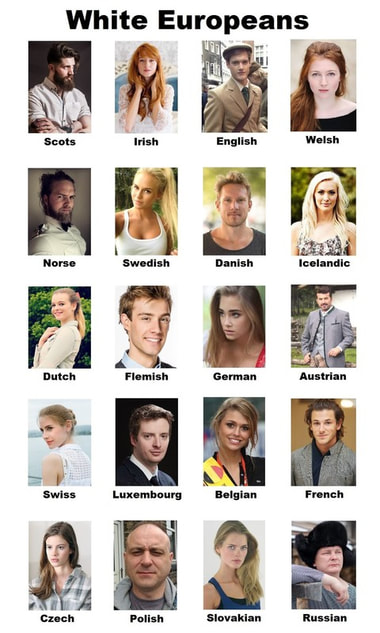
“To gain “cachet,” what does that mean? I am puzzled. Any information you can provide would be appreciated.”
So, by “cachet”, I mean political, social, cultural, religious, and economic power. To be identified as a white male was the only way to access citizenship rights.
African-American men were given the right to vote in 1870. But, the reality was that they were disenfranchised from voting by means test, illegal fees, and outright violence and terrorism.
To not be identified as “Black” allowed for cultural protection and an investment. It gave differing and various peoples from Europe an imagined and shared community. The notion of ethnicity was constructed. And, eventually celebrated
“Regarding “reparations,” I think that is absurd. It would be one thing if the year was 1870, and former slaveholders paid their former slaves. No problem for me. Slavery ended 155 years ago. Who gets reparations? Who pays reparations?”
First, the argument for reparations is more complicated than paying back lost wages. The argument for reparations is about the wealth that was built on slave labor. The wealth of this nation. The cotton industry. The agricultural industry. The railroads. The literal building of towns, villages, and cities. This country would not exist today as we know it without slave labor. We still all benefit from the infrastructures that were laid by their enslavement and labor.
https://www.businessinsider.com/american-landmarks-that-were-built-by-slaves-2019-9


Second, it is important to understand how individual wealth is created. It does not come from “pulling up your boot straps”. Individual wealth comes from generational wealth: income and assets that are passed on from parents to children, generation after generation. Wealthy individuals most often come from families who financially helped them in multiple ways. We have all witnessed this: buying cars for their children, paying for their education, putting a down payment on a house, etc. etc. Generational wealth also comes from what is called “White Affirmative Action”: legacy status at elite universities, nepotism, and/or professional connections, i.e. “who you know”.
Wealth from those early planters and landowners can be documented and linked to individual descendants today and to current white communities of wealth. We can identify businesses, corporations, and families who were slaveholders. And, we can identify descendants of slaves.
After the Civil War, the federal government promised enslaved free peoples the land that was held by the confederacy. (The 40 acres and a mule.). This did not happen. After Lincoln was murdered, Andrew Johnson became president. Johnson not only pardoned the traitors of the south, but he betrayed the freed slaves and denied them what was rightfully theirs. Confederate slaveholders and the planter class were allowed to keep their land, their homes and plantations, their animals, and all their personal belongings and goods.
Also, you have to remember the Civil War only freed enslaved Blacks in the Confederacy. Slavery was still legal in the Union States of Missouri, Kentucky, Delaware, and Maryland.
Black men were given the right to vote with the 15th amendment, however, they were usually physically beaten away from casting any ballot. Importantly, Reconstruction attempts to address the racial inequities were rarely implemented or enforced. Southern backlash forced the end to Reconstruction and after ten years the federal government withdrew federal troops from the south. During that time and after, thousands of African-Americans starved and were ultimately forced to work on those same plantations where they were enslaved.
Sharecropping — allowing a tenant to use the land in return for a share of the crops produced — became slavery by another name. Black farmers were charged outrageous land-tenant deals. Additional fees and interest for the costs of seed and tools were charged to those farmers. Cash that was offered for their crops was nominal, if at all. Often times any cash made by sale of a crop was used to pay back debts to the landowner. Black farmers were rarely able to buy their own land or get ahead. There was no protection under the law regarding the exploitation by the land owners.

Also, terrorist activities against African-Americans arose at that time. The rise of the KKK, the Black Codes, and Jim Crow laws all occurred during the post-Reconstruction era. Wealthy Black homes, businesses, schools, and even whole towns were destroyed, wiped out. Families were murdered. Decades of wealth lost and destroyed. Without the government even blinking an eye.
This annihilation of Black individual and community wealth contributes to the poverty that African-Americans experience today. They were the great-grandparents and grandparents of Black-Americans of my generation — baby boomers.
“My Grandparents came to North America in the early 20th century. They were never slaveholders. Should their descendants be forced to pay for crimes they were unconnected to?”
When our grandparents came to this country there were opportunities made available to them that were denied to Black Americans. Work in the steel plants, the police and fire departments, and other manufacturing jobs. Immigrants from that second wave benefited from the prejudices and discrimination that the first wave fought against. “Assimilation” became possible for European whites, because they were seen and ultimately accepted as “white”. If Blacks were employed in those spaces it was as low-level employees without the opportunity for advancement or increase in pay.
After WWII, our grandparents and parents were able to take advantage of governmental policies and benefits that excluded Blacks. Black GI’s returning from the war were not allowed to take advantage of any GI bills. There were denied those benefits for a variety of reasons. They were excluded from home ownership because of clauses that were written in real estate and mortgage laws. Refusing to buy, rent, or sell to African-Americans was legal. If they were able to buy, they bought homes at inflated prices and with severe penalties for late or non-payment.
“If your grandfather stole a horse 100 years ago, should you be forced to pay somebody for the horse? What if your grandfather never stole a horse, should you be forced to pay for a horse stolen by somebody else, 100 years ago? Why would people alive today, who may be black or brown, universally get reparations? They were not slaves. Some may not even be descended from slaves (Barack Obama’s father was Kenyan and mother was white. Should he get anything? Or half a “share“? Or how about nothing?).
This argument is what is called a “false equivalency”. We are not talking about a singular event. We are talking about millions of lives being brutally tortured and made to labor in back-breaking and life-taking work. Generations of lives. The argument is not about individual racism. It is about structural racism. And, how wealth of one group is dependent on the poverty and labor of another group.
A modern day example is the construction of damns that have been built in the Dakotas on Indian reservations to provide electrical power for white suburban communities. Native land that sustained native cultures for generations — farming, hunting, and fishing — was destroyed. In its place, the government gave native communities and families cash to buy goods from grocery stores. The loss of their homes, their lands and their livelihoods, which were thriving, caused an increase in poverty, an increase in physical health problems, and and increase in serious mental health issues. Government sanctioned genocide.
That is just one small example. My point is that one needs to look at the structures that are in place. Social security was also racially coded. “Southern employers worried that federal benefits would discourage black workers from taking low-paying jobs in their fields, factories, and kitchens. Thus neither agricultural laborers nor domestic servants—a pool of workers that included at least 60 percent of the nation’s black population—were covered by old-age insurance.” Thousands upon thousands of Black women throughout the country, for the entire 20th century, worked in white homes — taking care of white children and white families. For those women and other Black workers, there was no such thing as “retirement”.
“How do you determine and confirm that, even if you had “payers.” How about just treating everybody equally, promoting education, personal responsibility, living by the golden rule, among other positive attributes?
While I do agree that you make some good points, the idea of reparations is not one of them. The concept promotes entitlements for some and causes resentment in many others.
Besides the concept being wrong (in my opinion), it is divisive. Why in the world would you be promoting divisiveness? I would think that you would be supporting the concept that as Americans, we are one people. It is the concept of a “melting pot” that used to be promoted, in the past, and should be, again. By the way, the concept of a “melting pot” is implicit in its contribution to equality. We are all equal as members of society, which came from different backgrounds.”
I agree that we all need to live by the Golden Rule. But, we are not talking about individual relationships and engagements. And, clearly, given this cultural moment (and with the help of camera phones and the internet) we are witnessing just how ugly people can be.
Reparations need not be divisive. Holocaust survivors and their descendants of those tortured and murdered in the death camps were and still are being paid reparations by Germany and other nations, including the U.S. No one would deny them that benefit. Reparations are being made in Canada to First Nation communities for the taking away of native lands and livelihoods and the horrific abuse that they suffered brought on upon by the Canadian government via the “Indian schools”.
This is not about taking individual wealth out of every white person’s pocket and handing it over to Black people. The government is accountable. The U.S. government broke Indian treaties. The U.S. government betrayed enslaved African-Americans. The U.S. government denied its citizens protection under the law. And, the government continues to do so . Our government has been very quick to bail out the banking industry, the car industry, the airline industry and other large corporations when they are in financial crisis. The COVID-19 pandemic has made visible how low wage workers and small businesses are being left behind. How is it that large chain hotels are getting loan payments, waivers, and benefits using the small business loan grants?
Reparations can be made in multiple ways: individual payments; free college and educational training to Black and brown people; the destruction of ghettos and the construction of good and fair housing; penalizing (with jail) slum land-lords who prey on low income communities of color; building community centers and institutions that provide academic and cultural support; the provision of healthy food giving, buying, and growing opportunities in poor communities of color; and equal access to early childhood education and schools.
The United States has never, ever, formally apologized for the its history of enslavement, lynching, or Jim Crow. We have never had a truth and reconciliation moment or program like South Africa or Canada. Why is that?
I am of the generation that learned about the melting pot. (Today, elementary school children are taught that the U.S. is a salad bowl.) These are sentiments that do not accurately reflect the inequities that have dogged this country since the Revolutionary War and the construction of the U.S. Constitution.
It is important to think about these issues through the lens of systems — law and policy — that have purposely excluded and exploited Black and brown people. And, to think of these things in terms of community wealth and generational wealth. It is equally important to recognize that capitalism is an uneven economic and political system. Capitalism is a system of profit-making where wealth is dependent upon poverty.
His final response:
Thank you for your additional response. I certainly appreciate the courtesy.
Hopefully, someday in the future, when I am no longer working, I will be able to explore the resources you sent, completely.
However, I have to admit up front, I do not see how any reasoning being developed that has people who committed no crime paying a price to people who did not suffer from a crime. If so, perhaps you can get the Egyptians to pay reparations to the Hebrews (Currently known as Jewish people) who were slaves in ancient Egypt.
In any event, I admire and appreciate your efforts. Most academics would either ignore any challenge (by hiding under their beds) or accuse their challengers of being “racists, misogynists, haters, blah blah blah”. You have not, so I give you credit.
Thank you for your efforts.
My unkind and unsent response:
“Keep enjoying that cake, made from that oven, that you didn’t slave over.”

Endnote:
I absolutely and positively appreciate the kind and thoughtful way in which this reader engaged with me. I usually get a nasty response. It was wonderful to engage with someone in an adult and mature way. Therefore, I would like to sincerely send out a big, fat, thank you to that white guy, even though my words went no where.


George Floyd’s murder by four white police officers, and the nonchalance in which it was enacted, has finally outraged white America.White America can no longer ignore or dismiss the reality of what it means to be Black or Brown in America. As a white person, who has spent the last twenty years as an anti-racist activist, I have learned that there are two America’s: one for white’s and; one for everyone else.

Floyd’s torture and murder has called whites to action: petition, vote, advocate, march. These are great soundbites. But, we have to be careful. We can easily slip into empty gestures that do not create any meaningful change. It is not enough to stand against racism. We have to become anti-racists.
An anti-racist acknowledges that America is not white. We do not come first. We do not get top priority. Black and Brown people are not our guests. Our religion is the not the nation’s religion. In fact, none is. This ensures our rugged individualism and our democracy simultaneously.
As anti-racists we need to teach our kids how white citizenship was created to produce and defend subjugation. How the Irish, Italians, and Jews sued to be classified as white to gain cachet. We need colleges to offer classes and churches to create consciousness-raising groups that answer the question, “What is whiteness?” We are not an ethnic group or a piece of a multicultural pie. In fact, whiteness does not exist without Blackness.
As anti-racists, we have to acknowledge that most of our politicians, professors, lawyers, doctors, and other cultural and political positions of power are held by whites. As anti-racists, we need to buy products and goods from corporations where workers are well paid and protected. Cheap goods come from cheap labor; and we know those laborers are usually Black and Brown.
As anti-racists, we have to respect Native American’s sovereignty and recognize that compensation should go beyond the monetary. Government and corporations do not get to decide where pipelines go. We have to stop deciding what is and is not racism; we have been told: “Redskin” is an insult.
As anti-racists we have to stop pretending that plantations are ancestral homes and are actually historical sites of torture and violence. We have to implement a system of reparations for the history of enslavement. We have to support Black and Brown businesses.
As anti-racists, we have to see Courtland Rendford, not as a fugitive to run down, but as a young man whose crime was vandalism, not insurrection. City Hall isn’t“the people’s house.”
Can we do that White America? Can we be anti-racists? Can we stay the course for longer than 8 minutes and 46 seconds?


“Seeds Of Hope” are one minute radio messages offered by an Episcopal priest that send sentimental soundbites of optimism and promise to listeners. This “Gone With The Wind” seed of hope was first aired on April 29th, 2020 in response to the Covid-19 pandemic. The pandemic, mind you, that is killing Black and Brown people in disproportionate numbers.
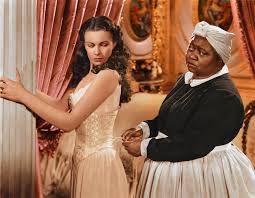
https://calvaryepiscopal.net/about-us/seeds-of-hope
The Reverend reads: (My thoughts in red):
“In the film, “Gone With The Wind” we first meet Scarlet [Huh?] as the privileged daughter of a wealthy landowner. [You mean slaveholder?] Scarlet, doesn’t like to think about anything unpleasant, so she says, “I won’t think about that now, I’ll think about that tomorrow.” During the hardships of war [Unlike being enslaved?], she chooses not to waste time and energy worrying. Her pattern is to put difficult decisions off until tomorrow, with the hope that a new day will bring a new perspective and new insights. [You think so?] The movie ends with the hopeful line, “After all, tomorrow is another day.” When we’re faced with a difficult situation, let’s take Scarlet’s advice. Don’t waste time and energy worrying. And, if we can, wait until tomorrow to gain a new perspective and new insights. After all, tomorrow is another day.”
This is seriously offensive. This “seed” speaks to white America’s banality, ignorance, and out right indifference to our nations savage history of enslavement and Jim Crow, to the on-going racial violence that our Black and Brown brothers and sisters continually experience, to the social, political, economic and health inequities they confront, and most importantly to the on-going murders of Black and Brown people by police.
Gone With The Wind is not a sentimental movie. It is a movie that minimizes the brutality of slavery and glorifies the “Old South”; it gives credit and life to the Confederacy. It continues to shape how people think and what they believe about our nation’s history. To say “It is just a movie” is to purposely downplay the lies it tells. Lies, that have became a narrative that continues to be celebrated and promoted. The movie has rewritten history and created the myth of a “plantation life” that gets accepted and celebrated.

Can you imagine a movie where the setting is Auschwitz and the lead protagonist is an SS Commandant’s daughter? And, a scene is written where the daughter is helped into her ball gown by a Jewish death camp inmate who is wearing striped pajamas? Could that narrative really be flipped and made palatable? Why then, can slavery?
I could write a book about what is wrong with GWTW. I could challenge a Washington Post article arguing that the book and movie are still necessary and relevant; or that according to the “literature experts” of E-note study guides it has a deep moral lesson “of survival in times during which traditions, ways of life and thinking, even love and understanding are gone with the wind, such as in the South during the Civil War.” ( Slavery was a tradition whose loss is to be mourned? ) But, my point is this:
“Why did this priest think that using this movie to send a message of hope was not only acceptable, but meaningful? Could he not find another movie, book, or heck, even a bible passage, that would suffice?” Why is this okay? Where is the disgust, outrage, or insult by listeners? “
This “seed of hope” is one example of the daily affronts that our Black and Brown brothers and sisters experience. To white America, they may seem inconsequential or harmless. But, these daily examples contribute to the “just get over it” mantra offered by white Americans to Black Americans. The lack of a critical response to such moments and/or experiences contribute to the cultural climate of ignoring our nation’s past which is played out in our present: as if there is no legacy of slavery; as if racism ended with the Civil Right movement; as if multiculturalism lessons and diversity training challenge the benefits and advantages that being white brings.


And the invisibilty continues…
George Floyd was murdered by police on May 25, 2020. White Americans are finally waking up to the callousness in which our Black and Brown brothers and sisters are treated in our nation. On Saturday, May 30th, Georgetown University Professor, Minister, and Author Michael Eric Dyson wrote on his twitter page:
“If you a preacher and you don’t preach tomorrow morning about what’s going on in these streets, you ain’t sh**.”
On Sunday, May 31st, I watched a Catholic Mass on EWTN, Eternal World Television Network, the most notable Catholic television programming in the U.S. During the homily, the moment of spiritual edification in the Catholic Mass, where scripture is to be made relevant to our current lives, not one word was spoken about the brutal murder of George Floyd, the mass rioting, or Trump’s failure and disregard. Not. One. Word.
As God is my witness, I will never think again.


Dear Another Voice,
I once wrote, “To be Black or brown in the United States is to live in a world that is less inviting, less responsive, and with a certain kind of pain” I also wrote, “To be white is to be able to walk down the street like you own it.”
My words were proven true at the 2020 Regional Future City Competition. It is a competition where middle school students build a city 100 years into the future. Students are expected to implement urban planning and infrastructure ideas, civil engineering skills, geography, and climatology. The final component of the competition is to build a 3-D model city and present it to a panel of judges. The only Buffalo Public School to compete was Marva J. Daniels Futures Academy. It was the only team that was all African-American. The other teams hailed from the suburbs and were (mostly) all white.
What does it mean when a group of young Black faces walk into a suburban school and say, “We don’t belong here”? What does it mean when those same kids face judges who are all male and white? What does it mean when those Black kids see white kids build cities in The Congo, Morocco, and Zimbabwe?
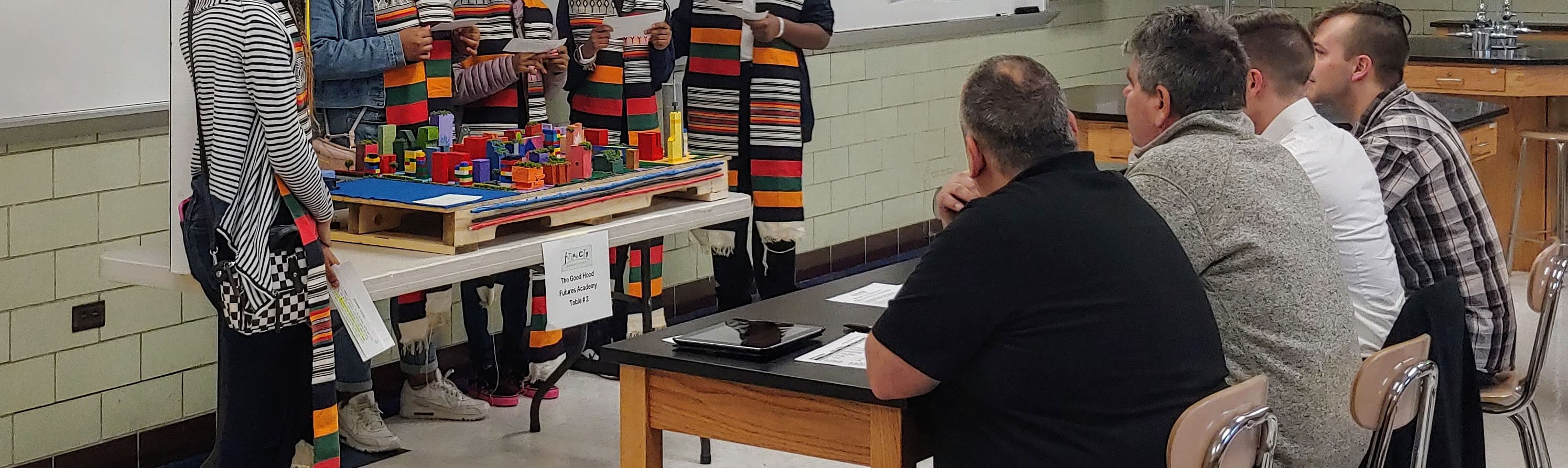
The teams that won imagined their cities with skyscrapers made of steel, mono-rails in the sky, jelly-fish water purification systems, micro-chips in citizens, solar panels, and air wells. One team’s city was visited by Prince Harry. Another made a point: “We kept some huts to maintain the culture.”
The imagined cities created by these students were filled with scientific wonder and creativity; a future with infinite resources, green infrastructure, and limitless possibility. Unfortunately, those same cities lacked any historical, political, or environmental reality. They imagined a future devoid of any past.
I do not blame the kids. I blame the teachers. When the students suggested microchipping the inhabitants did the teachers not educate the kids about government surveillance or the policing of communities of color? When the students suggested that their African city get a visit from a British royal did they not stop to talk about colonialism? When the students suggested building high rises in the desert did they not stop to educate their kids about desert climate and local knowledge. (Huts in African desert spaces are made mud, clay, and twigs for scientific and practical purposes.)
The Future City Competition is a reflection of the difference between a Black and white lived reality. It is why “Redskins” is a football team. It is why Colin Kaepernick should just “shut up and play”. It is why Flint, Michigan still does not have clean drinking water. Experiences don’t change. Pain for some. Comfort for others.

The Sky is Blue.
The grass is green.
Black people suffer.
I wrote this poem in reaction to white people who believe that Black suffering is inevitable and normal. The acceptance and apathy regarding the daily pain of insult and injury experienced by our Black and Brown brothers and sisters, daily pain of insult and injury that is caused by white indifference, insensitivity, hostility and rage — all unjust — is mystifying and frightening.
One need not look at the ugly speak of Mr. Trump: i.e. the invasion of rapists and murderers at the Mexican border; the very fine people that can be found in “Unite the White”. Or at the numerous threatening behaviors against Black students on college campuses: getting arrested by police at the library; nooses and bananas being hung on dorm doors and building elevators. Or more violently: the deaths of our Black and Brown brothers by cops who overreact; or white teen boys and men who hate.
One just needs to read in the paper a story about a white doctor who complained about being treated “like a Black person” when he was arrested at an American Airlines ticket counter at the Orlando International Airport. The good doctor became enraged when he was told he was too late to check in. When police arrived at the scene he began yelling insults to the officers. He resisted arrest by falling to a ball on the ground. Yes, he was pepper-sprayed, but he was given a heads up. As officers struggled to put him in handcuffs he yelled, “Oh my God, I am being treated like a Black person.”
The indignity is about being “treated like a Black person”.
Not how Black and Brown people are treated.
In Western New York, white players from a hockey team called a seventeen-year-old opposing player who was Black a monkey while making monkey gestures and sounds. They did so leaning over the boards near his team’s bench. Not one white person, in that moment, yelled at those kids: not the officials; not their coaches; not their parents; not their teammates. It was recorded, but no other intervention was made. A Buffalo News editor asked, “Why did these teenagers think it was all right to behave that way?” and, “Where did they learn that?” Really, sir? You don’t know the answer to those questions?
Perhaps that news editor should look outside his window at the town and county in which he lives. Confederate flags can be found hanging from porches. The Blues Live Matter flag can be found on the bumpers of cars, on t-shirts of gym goers, and even hanging from one Buffalo district police station.
Can you imagine the response and backlash if the Black Lives Matter movement created their own flag: an American flag with a thick black stripe?
The Blue Lives Matter “movement” is a direct and hostile reaction to the Black Lives Matter movement. The implied “too” is not even subtle. That movement was law enforcement’s public response to the BLM movement. Colin Kaepernick knelt during the national anthem — kneeling, in and of itself, is a sign of respect — to call attention to the number of Black lives that were lost to police brutality. A call to action by all citizens was made. But, instead of listening, and accepting the data, and admitting, that “Yes, we have a national problem with police brutality”, the law enforcement community reacted. The thin-blue line embedded within the United States flag is an assertion of police power and authority. Their assertion, that “we matter too” is defiant. Because we all know police lives matter.
Every child growing up in the United States learns that police officers are to be respected and valued.
A police officer’s testimony in the court of law carries more weight than your average citizen’s. How many of us have donated to the Police Benevolent Association without even questioning where our donation dollars go? We are just happy to get the PBA sticker to put on our windshield in hopes that it will discourage an officer from giving us a traffic ticket. Police troops are represented in our parades. Police officers are invited as honorees to our block parties. And, now we can even go for a cup of “Coffee With A Cop”.
It is important to question the creation and embracing of the Blue Lives Matter movement. It’s very existance dismisses and silences Black suffering. The importance of the Black Lives Matter movement; a movement to address the numerous social injustices that occur in our deeply, divided, racialized country — where the poles of difference have remained constant: white supremacy and Black subjugation that marks the social bottom — is made insignificant and irrelevant.
Even more telling and scary:
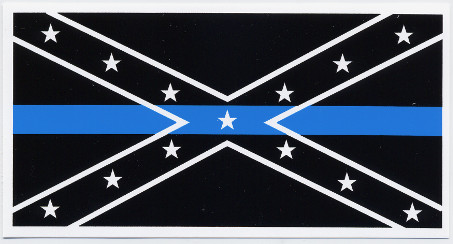
The insertion of the thin blue line with in the Confederate flag speaks for itself. It cannot be denied that the confederate flag is a treasonous flag; a symbol of Black enslavement and Jim Crow. A symbol embraced by white supremacists and to threaten African-Americans. The power of privilege allows whites to argue that the Confederate flag is nothing but a symbol of Southern pride; and to argue that symbols (and words, such as Redskins) can be a racial slur, but not always. In other words, to be white is to assert that ugly, insulting and racist slurs and symbols can be separated from their history, definition, or intention.
The Sky is blue. The grass is green. Black people suffer.

On February 9, 2018 the film was screened at The Burchfield-Penny Art Center. Following the film was a interactive panel discussion on race. The topic, “Why All the Talk About Race?” There were six panelists, however most prominent were Dr. Henry Louis Taylor, University of Buffalo Professor and Director of The Center for Urban Studies; Mr. Carl Paladino, billionaire businessman, founder and chairman of Ellicott Development Company, and Mr. Larry Quinn, real-estate developer by trade, past managing partner of the Buffalo Sabres, and at-large member of the Buffalo Board of Education.
“The main purpose of the film is to spark dialogue and encourage people to talk about things they may be uncomfortable with. Hopefully it will be therapeutic.”
Korey Green
This is what the Buffalo News reported:
https://buffalonews.com/2018/02/09/paladino-has-his-say-on-race-at-forum-then-vows-to-listen/
This is what I reported: which was not published:
The Buffalo News reported that “Carl Paladino said his piece during a forum on race Friday at the Burchfield-Penny Art Center… but he choose to listen more.” I was there. Let me be clear. That did not happen.
The panel discussion was a follow-up to the screening of “The Blackness Project”, a film directed and co-produced by Korey Green. Mr. Green made the film in response to the on-line film “The Whiteness Project” created by Whitney Dow. Dow’s project offers a platform for white people to speak freely about race. Dow said he made the film because “we white people need to deal with our own shit.” Unfortunately, the attempt to engage white people falls dangerously flat as the participants and viewers are never asked to examine the stereotypes and inaccuracies they espouse. Green’s film is a counter-narrative, and is better. The participants in his film speak honestly and painfully about their experiences as Black-Americans. More importantly, Green’s film is charged by interviews with academics, public intellectuals, and political actors. Their voices bring not only an historical analysis to Black racial oppression, but wisdom, insight and at times, humor.
The panel discussion titled “Why All The Talk About Race” was very telling and seemed to mirror the two films. There wasn’t any conversation and there wasn’t any listening by either white panelist, Carl Paladino or Larry Quinn. That they were invited was confusing. They are capitalists; not critical thinkers. And, worse, not only has Paladino attacked Black civic leaders, he has made vile, racist, statements about President Barack Obama and Michele Obama. His defense; his comments “were not intended for the public.”
When asked what role racism plays in our society, both white panelists did what white people do when taking about race; they looked at their black and brown brothers and sisters in the eye and told them what is and what is not racism. Like the supporters of the Lancaster Redskins telling Seneca Nation representative Al Parker that the term “redskin” is an “honor”, even though Mr. Parker is telling them, “It is not.”
Larry Quinn actually said, “black people need to get past the idea that there is a force in this country that wants to subjugate you.” Jeff Sessions’ use of the phrase “Anglo-American heritage of law enforcement” was no accident. The travel ban on Muslims, Trump’s push to build a border wall, FEMA’s abandonment of Puerto Rico, the murder of Black civilians by police, and the disproportionate numbers of Black men incarcerated for crimes white men are not — they all speak to intentional racist practices of law. To blame and reduce American racist policy, as Quinn said, “to the Southern government up until maybe recently” shows willful ignorance.
Carl Paladino was particularly disrespectful during the panel discussion. He centered the conversation on himself and his past role as a board member of the Buffalo Public Schools. He spoke over the other panelists (especially when Dr. Henry Taylor was speaking) and when Mr. Jamil Crews spoke of the role that Donald Trump plays in promoting hate, Mr. Paladino rolled his eyes. Paladino questioned the need for Black History Month. He charged Black women educators with racism because “they do not support charter schools”. He accused Black civic leaders of not caring for children.
How is that “listening a little more instead of talking?” Had Mr. Paladino been listening he would have learned that Black History Month is not just a celebration of Black America’s achievements and stories, but rather a deliberate political strategy for blacks to be recognized as equal citizens. Without it, Black achievements would not be part of any historical narrative. Had Mr. Paladino been listening he would have learned that Black Americans are wary of charter schools because of the history of excluding Black children from public schools, and currently, public schools of excellence. Charter schools are more racially isolated than traditional public schools, they have higher expulsion and suspension rates for Black students, and many are run by evangelical Christian churches which often teach unaccredited curriculum, curriculum which flouts science and historical fact. Had Mr. Paladino been listening to Dr. Taylor, he might have learned about the numerous Black community organizations that have for years and years worked toward Black economic, educational, and political parity.
Mr. Paladino and Mr. Quinn did not “participate” in the panel discussion on race. They did what white people do when asked to talk about race. They believe they have a right to speak, to be heard, and to be counted at all times. They believe they can hide behind their ethnicity, gender or poverty to dismiss the voices and experiences of non-whites. They disparage political correctness, deny history, and even distort reality.
Throughout the film, Dr. Taylor spoke of a general lack of remorse by most white Americans when it comes to the brutal treatment of African-Americans and other minorities in this country: past and present. To that I would add a total lack of shame.
Less than a year ago, CBS This Morning did a story on the film “The Blackness Project” directed and co-produced by Korey Green. The film encourages people to talk about “race-related issues that can be uncomfortable.”


“White privilete is your history being part of the core curriculum and mine being taught as an elective or only briefly discussed during Black History Month.”
Eton Thomas (author, activist, professional athlete)
Black History Month. We should not need it. But we do. Is it a conundrum? Yes. “Black History” is not separate from American History. Yet, without a conscious and concrete effort to make visible all the myriad ways that Black History is American History, would those histories be told and be told honestly? What happens when Black History is told by white America?
White Americans like their past re-imagined, glorified, and made nostalgic. The cultural and historical references and images are made palatable. African-Americans, Native-Americans, Asian-Americans, Middle and East Indian-Americans, and all other non-white Americans are expected to agree and relate.
A perfect example of a re-written and re-imagined history can be found in Lexington, Kentucky at the Waveland State Historic Site. Once an Antebellum Plantation, today a “Living History” museum.
http://parks.ky.gov/parks/historicsites/waveland/
“This beautiful Greek Revival home was built in 1847 by Joseph Bryan, a grandnephew of Daniel Boone. Tours of Waveland focus on the Bryan family and life on a 19th-century Kentucky plantation. Waveland exemplifes plantation life in Kentucky in the 19th- century; from the acres of grain and hemp waving in the breeze (hence the Waveland name), to the raising and racing of blooded trotting horses.”


Living history events include butter churning, doll making, military drills, and period games; even a Valentine’s Day Tea including finger sandwiches and scones served on fine china by costumed “interpreters”. (Will there be costumed “slaves”?)
 The kitchen and slave quarters. “Without their labor, Waveland would not have been possible.”
http://www.kentucky.com/news/local/counties/fayette-county/article44364669.html
http://www.kentucky.com/news/local/counties/fayette-county/article44105457.html
“I would use the the verb “enslaved” rather than the noun “slave” to implicate the inhumane actions of white people. “Enslaved” says more about what happened to Black people without unwittingly describing the sum total of who they were.”
Deborah Gray White, Ph.D. (Distinguished Professor of History)
What is privileged– made dominant and idealized– in this white re-telling of Waveland is the architectural and artifactual elements of the plantation, the way of life of the Antebullum slaveholders, the beneficence of the slaveholders towards their slaves, and the legacy of the Bryan’s family enduring contribution to the City of Lexington.
What is ignored is the buying and selling of Black bodies; the brutality of slavery; the psychological costs of enslavement; child abuse and sexual abuse of enslaved children and women; the tearing apart of families; the horrific demands of field labor; and the dependence on the caprices of the master.
The only reason white men were masters and white women were mistresses is because Black men and Black women and Black children were enslaved.

Sally has straight hair. Sally wanted curly hair just like mother’s. Sally went to the store and bought a curling iron.


“Oh, no!”, exclaimed Sally, “This curling iron is for Black people”. Sally looked closely at the box. Yes, the model on the cover is Black. Sally went to the store and returned the curling iron.
She went to the hair care section to look for a curling iron for white people. “Oh, no!”, exclaimed Sally. There did not seem to be a curling iron for white people. All the models on all the boxes were Black.
Sally did not want to ask the salesperson for help. She looked at all the boxes. She read all the directions. She was confused. Are these curling irons for white people or Black people? The directions did not say.


Sally did not know what to do. She decided to buy the curling iron again. She would take the iron out of the box to see if it would work on her hair.
When Sally got home she opened the box. This is what Sally discovered:
Just an ordinary curling iron. Silly Sally!
Moral of the Story:
Sally is a silly, stupid, spoiled, white girl who is used to seeing images that reflect her race on each and every product that she wants to purchase. The “I” is always white.
*This is based on a true story.


What is up with the popular resurgence of images from the post World War II and the pre-rights era (civil, women, LGBTQ, American Indian, etc.) in our country? The desire for this nostalgic throwback in “time”, with it’s almost total absense of people of color, and especially the absence of our violent racial history — a literal and figurative whitewashing — speaks to popular culture’s desire to perpetuate and sell Trump’s mantra of Making America Great Again. These images are everywhere. And we know is who is buying them: white Americans.
The creation, production, and reception of images is important. Images become a kind of memory. They render, imitate, interpret, and preserve. They hold, unchanged. Image making functions as the tool for the construction of identities. But, what happens when those images are created by the dominant culture? And, what happens when those images are reproduced ad nauseam?
They reinforce the “histories”, ideas, values, and perceptions of those who control cultural and political production.
Try an experiment. Google “Retro Images” and see what pops up. White America. Open items on the menu bar: Christmas, Woman, Good Morning, Diner, Party, Baby, Easter, and even Groovy and Cool, and you will immediately find images of white people. It is as if people of color never existed.
Also, what does our culture’s hunger for retro images, items, and products really mean? There seems to be a white collective belief that “everything old is cool again”. The 20th Century may have been a time of technical and medical innovations, but it was also a century of race-wars and race politics. The luxury of being white is the belief that one can step outside of the history of race and racism. The luxury of being white is to pretend to be “color-blind”: as if one does not notice the color of skin, just the content of character. The hypervisibility of white culture in retro media and images creates and promotes more than just an aesthetic. It creates and promotes a history that is absent of race, racism, and racial upheavel. It creates and promotes of culture of whiteness as normal, desirable, and American. And, most importantly, it creates and promotes the idea that anything and everything that is white is superior.
The flood of Retro games available speaks to a collective desire for the past. But, whose past?


“When I was in elementary school, this white, owning-class family was presented to me — a southern, semi-rural, poor American Black — as an opportunity to learn to read and at the same time to understand what the typical American family experience was. Of course, when I was in elementary school, I didn’t know that most white Americans were not living like that — and I think that most of my Black teachers believed in the Dick and Jane story too.”
Clarissa Sligh, Artist
Retro images that are produced and re-produced do affect our culture. It doesn’t matter if they are tongue-in-cheek spoofs , a Little Treasure or a self-help book sold at Barnes & Noble, or a design concept from Architectural Digest.


They perpetuate a false history and narrative of American culture. They create a cultural climate; they contribute to a culture of whiteness that becomes synonymous with family, love, home, style, wealth, desire, identity, and especially nation.
The celebration and glorification of all things white is what lies behind the Make America Great Again movement. To paraphrase the brilliant historican, activist, and Harvard scholar, Dr. Henry Louis Gates;
“Eight years of a Black president drove a lot of people crazy!”
Celebrating a white-washed past of a literal raceless America, and longing for a childhood world that did not exist, is much more appetizing to the general white public than joining a white nationalist group. The examination of this popular trend is uncritical and unsophisticated. Critical analysis is reduced to sentimental commentary; with the worst being; “it is dated” and the best being; “they bring back delightful memories of childhood”. Again, I ask, delightful for whom? Again I write, the “I” is always white.
(And to think I purchased my sticky notes folio at a World Market store in Phoenix.)


Dear DeTrading Post Shop Owner,
You made my friend and I smile when you handed back change from our purchase. You said, “1967. It was a good year”. When I asked you why you thought that, you said, “Because everybody was hopeful then. We believed that things were going to get better. We treated each other with respect.” It was sweet to hear.
I thought the small talk was over. I really didn’t want to engage. I wanted to take my purchase (a lovely leather and bead bracelet) and get back out into that gorgeous sun, heat, and blue, blue, sky. But, you continued with your commentary. I assumed you were going to complain about Trump’s tweeting, the border wall, or even the Mueller report. It was clear from your accent that English was not your first language. I assumed you were either Native-American or from South America. Arizona may be a Republican state but most non-whites who live there identify as democrat or liberal or Mexican. However, you threw us for a loop when you asked us if we knew who “Adam’s first wife was?”. I did know the answer. “Lilith”, I said.
Apparently you mistook my response for an invitation to share your ideas. Lilith, you told us, was evil. You warned us about the evil that exists in this country. And, here is where the conversation got really scary. You complained that we have “Muslims in our government and the next thing you know we are going to have Sharia Law in our country.” I countered with the first thing that came into my vacation-addled brain. “So, are you okay with the U.S. doing business with Saudi Arabia?” I cannot remember what you answered. You blamed, “Bill, Hitlery, and Obama” for bringing “Muslims into this country.” “Hitlary?” Yes. “Hitlary Clinton, who is just like Hitler”.
I continued to listen to you politely. You extolled the virtues of Judaism and said it was the most progressive of all world religions. You made a joke about Jewish women being closer to God than Jewish men. You also said: that you loved Trump; that Trump is helping us to see who our real enemies are; this country is the best country in the world; and that you would die for this country. You ended your monologue by saying “If people don’t like it here then they can go back to where they came from”. I made no gesture of annoyance or discomfort. I just kept smiling. When you were finished, I thanked you for sharing your thoughts, shook your hand, and exited your shop.

Do you remember me shopkeeper? I was the woman wearing the Free Palestine t-shirt. Now that my vacation has ended, and I have had time to think about our “conversation”, I would like to ask you several questions.

Thank you for reading my questions. I hope my letter helps you for the next time you talk with your customers about political issues.
Peace Out,
iiswhite

This is my response to the dreadful Fashion Focus column by the Home and Style Editor, Susan Martin, of the The Buffalo News. If you read it, you would think that the only “fashions” worth reporting are those worn by mostly white, middle-class, shop or gallery owning, suburban-looking types. Most, who I assume, are her friends.
https://buffalonews.com/topic/fashion-friday/



Name: Henry Louis Taylor, Jr., Ageless
Who He Is: A Black-Marxist Intellectual, Scholar, Full-Professor, Writer, Activist
Soldier, Warrior, and probably someone’s lover. Or depending on your perspective, a really scary, and angry Black guy. A Tennessee native with a penchant for raining on people’s parades, who came to Buffalo because the struggle is really happening here. He’s won multiple awards and is affiliated with numerous professional organizations. You will not find him at The Buffalo Club. Nor is he an “Uncrowned King”.
He can’t sing and he can’t dance. But, he can act. He knows all the lines to The King and I. He can whoop your ass ‘cause he knows karate. He exercises regularly to maintain a level of fitness that keeps him ready to work at all hours of the night, and morning, and day, and evening. Oh, and he drives a little sports car that he named, “El Diablo”.
He is a black cat: smooth, singular, and indifferent.

What He’s Wears:
Whatever the fuck he wants! The important question is what he won’t wear: a Polo golf-shirt, a suit with a tie, Sperry boat-shoes, socks with sandals (unless it’s really cold in the office because the air-conditioning is on and no one else is around), a leather logo jacket, a sweater vest, or anything that is defined as being “professional” or that screams “white-guy”.
Signature Pieces:
1) Sunglasses: A Black-Marxist Liberation Movement soldier has no problem looking white people in the eye. But, sometimes, that soldier cannot afford to be identified.
2) Wrist Cuff: In direct opposition to the cuff-link, Taylor can always be seen with an Afro-centric leather cuff, a Native-American silver cuff, or a beaded bracelet made by one of his beloved students from Future’s Academy.
3) Necklace: An Inuit face-mask scrimshaw carving on a leather cord.
Fashion Statement:
Cool by all standard definitions. The fashion intellectual center of the left in Buffalo; and uncompromising in his resistance to the oppression of the established fashion order. Upscale (i.e. expensive) athletic sports clothing: Black Hugo Boss sweat-pants coupled with a black Calvin-Klein (super soft t-shirt) and a black or brown military-style sneaker.
Last Purchase: He won’t say.
In The Market For:
A pair of Fort Belvedere Napa-leather, hand-woven, driving gloves, with an adjustable snap-button and woven knuckle pattern, in British Racing Green and Off-White.


In 2016 Colin Kaepernick took a kneel to protest police brutality. The NFL owners reported that they felt “under assault”. Trump told them to “get that son of a bitch off the field.” And, fans reacted as if the football field was a political-free zone and told Colin that he “should just focus on the game”.
In 2017 Kaepernick remained an unsigned free agent. According to the Washington Post, signing Kaepernick “would be far more than a football decision.” The Buffalo News reporter Bucky Gleason wrote that hiring Kap would bring “controversy over something that has nothing to do with football.” And, Houstan Texans owner Robert McNair [now deceased] told fellow owners that the NFL “can’t have the inmates running the prison.”
Last September Nike used Colin’s activism in their Just Do It ad which read “Believe in something. Even it it means sacrificing everything.” Once again, people reacted. A Louisiana mayor wanted to ban Nike products from the city. The hashtag “boycottNike” erupted with images of people burning Nike products. And, some Christian colleges banned Nike products from their campuses.

It is early 2019 and Kaepernick is no longer a professional athlete. The NFL tried to ban players from any kind of protest, until they realized that such a ban was unconstitutional. And, most recently, the Wisconsin GOP leaders removed Wisconsin-born Kaepernick from a resolution recognizing Black History Month and Kaepernick because they considered him too “controversial” to be included.
Let’s be honest. Kneeling is a gesture of respect. More importantly, it has only been white America who has reacted with such hostility to Kap’s support of the Black Lives Matter movement. And, to other Black athlete’s who continued the conversation. Remember Laura Ingraham telling LeBron James to “shut up and dribble”? It is white America who believes they have the right to tell Black and brown people when, where, and, how to protest. It is white America who tells Black America who their heroes should be.
Nike does not speak for white America. Nike is a global corporation. Nike knows that many of their consumers are people of color. Nike knows that “Taking the Knee” is the modern-day legacy of Tommie Smith and John Carlos giving the Black Power Salute at the 1968 Olympics. Nike knows that Black athletes have a long history of being social justice activists; and those beliefs have always cost them something, if not everything.
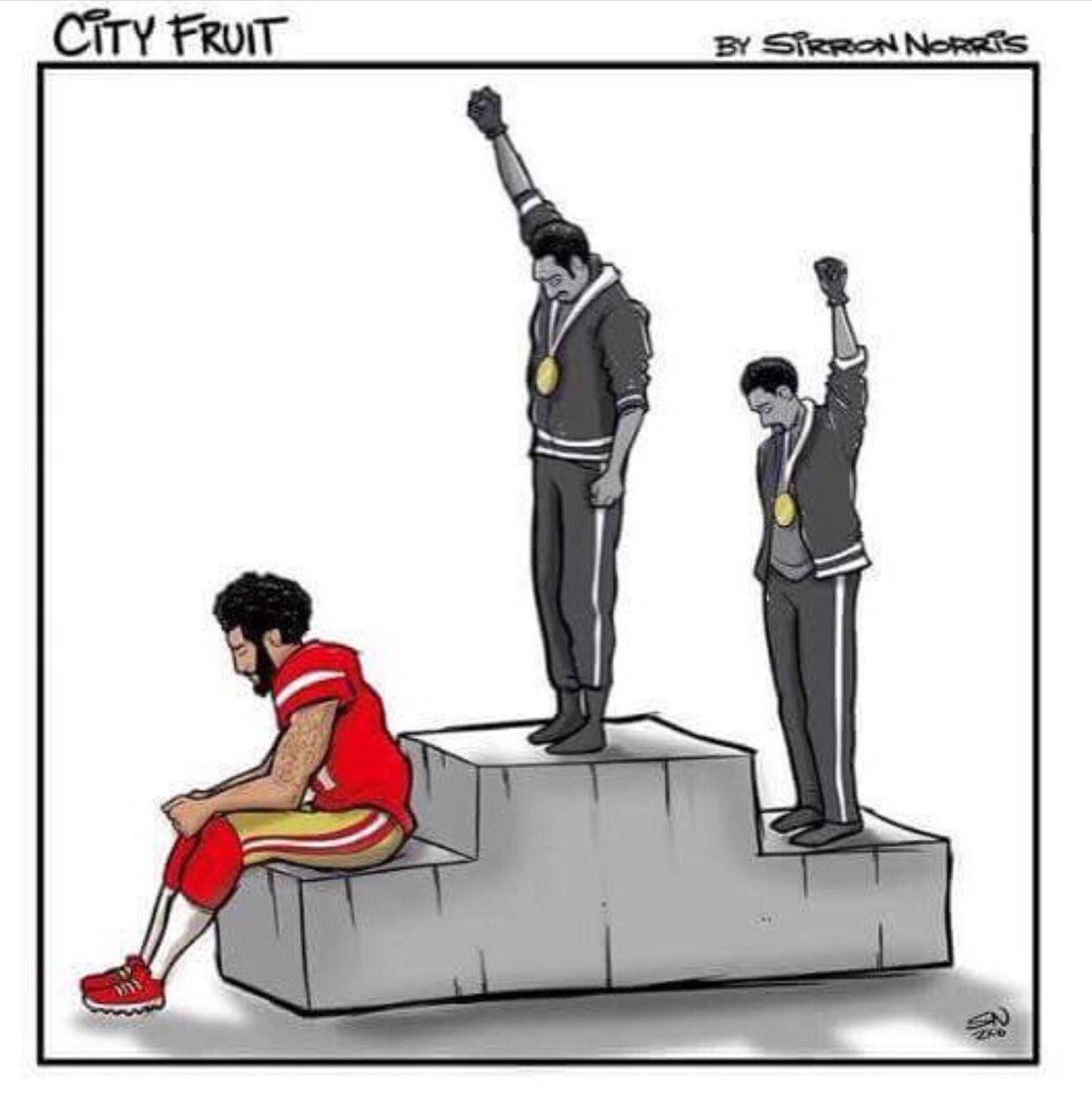
The irony is that Nike’s ad truly represents American patriotism. Because to believe in something, even if it means sacrificing everything, is the American way. Abraham Lincoln. Sitting Bull. Sacco and Vanzetti. Malcom X. So, white America, be honest with us about why you hate Colin Kaepernick. Accept the the fact that like Muhammad Ali, Kap will go down on the right side of history.

 (I am just going to start out by saying that this so-called documentary, project, interactive whatever, is: cringeworthy, telling, and painful to watch. I have yet to decide if it adds to the conversation on whiteness.)
Filmmaker Whitney Dow, who has been recognized as “making smart films about race” with Marco Williams (or as Dow refers to him, “my Black producing partner”) decided to get serious about race. Dow believes that, “If white people are going to participate in changing the racial dynamic, we need to deal with our own shit.”I agree. In 2014 Dow premiered his documentary, The Whiteness Project, on PBS. The project is a multi-media documentary described as an investigation into how Americans who are white identify with being white.
Dow gets that white supremacy is one of the central organizing forces in American life and, that white is “the most powerful racial identity in America”. He does not want white Americans to get away from identifying themselves as being white. During an interview with CBS, Dow argued that being white is a defining characteristic that actively “impacts every interaction of every moment in our day.” The goal of his project is to encourage debate about the role of whiteness in American society among white people; people who “have been very tentative about engaging.” He offers the project as venue to help white people reflect on white identity and white privilege.
The Whiteness Project website states:
“By engendering debate about the role of whiteness in American society and encouraging white Americans to become fully vested participants in the ongoing debate about the role of race in American society, The Whiteness Project aims to inspire reflection and foster discussions that ultimately lead to improved communication around issues of race and identity.”
White individuals are filmed within a white frame with an intense focus on their face. There are no other distractions: no background, no interviewer presence, no interviewer voice. The viewer immediately understands that the participants are asked a series of questions about being white in general. The only conversation in the film is when the participants are talking to the camera. The audience gets to know the questions only from the interviewee’s comments, such as; “Do I think it is beneficial for me to be white?”, “Do I think about race?”, or “Do I feel a common bond with white people?” Between each screen interview a statistic is given. The statistics are there to help the audience place the views in a societal context and, to hopefully provide some fodder for self-reflection.

Described as “an interactive investigation into how Americans who identify as white, or partially white, understand and experience their race.”
In one word: Scary

Described as “an inspiration from conversations about the “Whiteness Project” which is a similar documentary discussing race and the perceived loss of white privilege by white Americans. The main purpose of The Blackness Project film is to bridge the gap between white and black Americans with in depth interviews on race.”
In one word: Brilliant


This is an oft-repeated statement by activist and scholar, Dr. Henry Louis Taylor. Dr. Taylor does not reject sexual or marital relationships among Black, white, and brown skinned peoples. What he rejects is the myth that these relationships by themselves will confront and defeat racism and racist practices — individual and institutional. He points to the color of his own light-brown skin; what in another time and place would have been referred to as “high-yellow”.
Dr. Taylor was quoted out-of-context when being interviewed by a FOX news reporter about the movie Green Book. In that article he said, “We can get caught up in the controversy about whether or not the film is an account of the white’s man’s view, which it is, and whether the story would have been different had Shirley told it, which it would have. But that doesn’t matter as much as the larger question,”What is the place of individual friendship within the process of social change?” What was excluded from that article was his answer.
“Individual friendships are important only if they inspire and incite the fight against structural forces that produce racism, prejudice, and discrimination.” (1/13/2019)

Obama’s farewell speech, which was directed at Trump supporters, i.e white people, was full of glory and exaltation.
“For 240 years, our nation’s call to citizenship has given work and purpose to each new generation. It’s what led patriots to choose republic over tyranny, pioneers to trek west, slaves to brave that makeshift railroad to freedom. It’s what pulled immigrants and refugees across oceans and the Rio Grande, pushed women to reach for the ballot, powered workers to organize. It’s why GI’s gave their lives at Omaha Beach and Iwo Jima: Iraq and Afghanistan – and why men and women from Selma to Stonewall were prepared to give theirs as well.”
Where is the space for our Native American brothers and sisters? Our nation exists because of the genocidal atrocities committed against Native Americans. The omission of this historical reality was especially glaring in light of the current events at Standing Rock. But, consistent with the re-writing of American history.


“Hey, I just read your [Confessions of a White Girl] essay – it’s fantastic! I absolutely feel you about the ability to “turn off” and just forget about the problems – the privilege of being able to do that has definitely shaped me as a person. And, I agree that it’s a core aspect of what it means to be white – or male, or straight, or economically well off or any number of things. So many of these issues are really just abstractions to me, and the ability to just say, “all right, I can’t think about this anymore or I’ll go crazy” is just such an easy thing [for me] to do. I would imagine that that same attitude is what King talks about in his Letter From a Birmingham Jail. It’s why I don’t like qualifying my support for feminism or social justice or any other like causes. My intellectual comfort isn’t really important in these discussions about real issues that people must face all the time. I’m excited to read more of the book.”
Who is this white person who took the time to find my address and mail me this postcard?

SOMEBODY NEEDS TO GO BACK TO SCHOOL!
According to the FBI, I am more likely to be a victim of a crime committed by a white, heterosexual, male — whom I know — than by a person of color.
“I bet she’s a lot of fun at the dinner table.”

We are drawn to the visual. When we look at images we witness and experience many collisions: public and private, past and present, real and staged, Black and white, “I” and “Not I”. Our relationship to the world is often mediated through images. Our response to images situates our relationship to the world. Images can create a shock of discontinuity. They make difference plain. Images remind us if our versions of reality match. Images carry a weight.
Images do not preserve meaning. Meaning is determined by one’s response to the image. This response, this space, which can be either an abyss or an attachment, defines the moment where the simple act of looking confirms or denies one’s sense of being in the world.
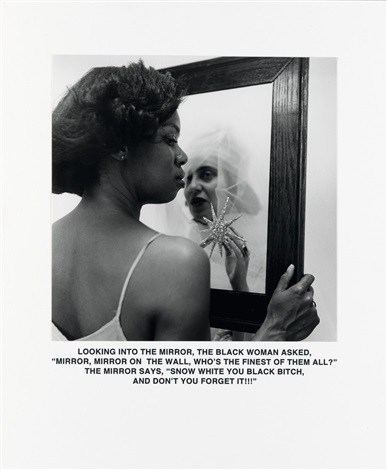
The May 2019 Buffalo News edition of their Buffalo Magazine issue titled, “The Food Issue” is a concrete example of the “I” is white. From cover to back page all of the articles feature white individuals and their stories. The neighborhoods identified in the article are either white suburban neighborhoods [East Aurora, Elma] ,upscale and gentrified white neighborhoods [Hertel Avenue, Downtown], or up and coming working class neighborhoods [Allentown].


From back to front there is only one image — one image — of a person of color. And, that image is of a child in an ad for summer camps.

Readers, especially those who are from out of town, would never know that a Black or brown or any non-white person lives in Western New York.
At the 2010 census, the racial composition of Buffalo was:
Why is it acceptable for The Buffalo News to print a seventy-page magazine about eating, fine-dining, and picnicing in metropolitan Buffalo and only write about white Buffalo and show white Buffalo?
Especially when the editor wrote in her “From the Editor” section in the magazine that her intro to the Buffalo restaurant scene was the “West Side Bazaar”.


Images substantiate culture. When images are produced by those who politically control the cultural production, they become easily accepted and consumed. It is a more than a misfortune if our eyes have grown accustomed to images that reflect only white America. It is the simultaneous danger of the invisbility and the hyper-visibility of whiteness.
The image is always white. The “I” is always white.

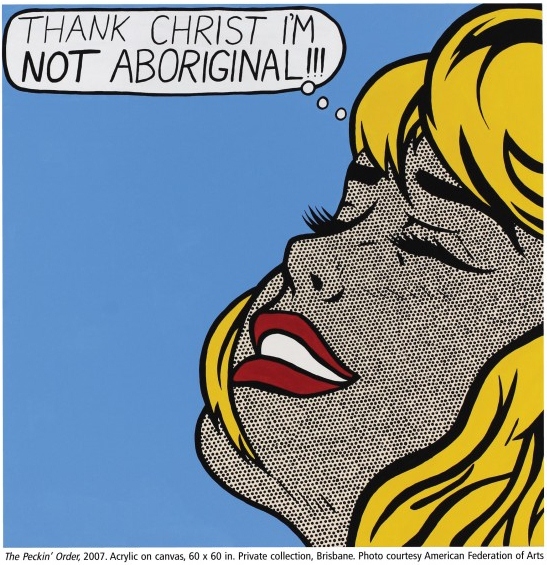
Richard Bell is — in his order — a political activist and artist from Australia. He is a member of the Aboriginal Kamilaroi tribe and one of the founders of proppaNOW, a Brisbane-based art collective which works to “change ideas that people have about what Aboriginal art is and what it should be.”
“ABORIGINAL ART — It’s a white thing!”
Bell creates counter images from commonly known pieces of art and embeds them with text to get the attention of the viewer and to make his point.
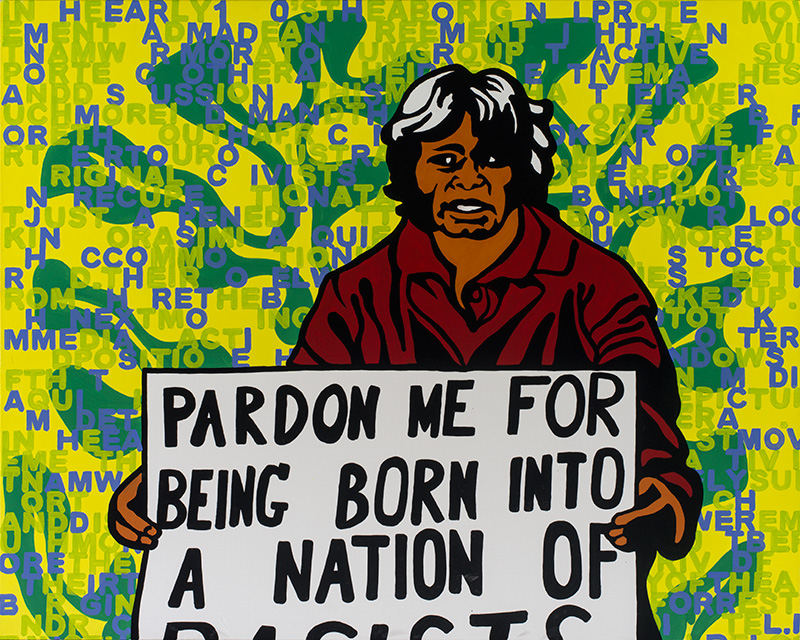
Bell forces the viewer to look at issues of racial history, cultural history, relationships of power, controlling images, colonialism, paternalism, and racism. He describes his art-as-activism as “conversational, playful, tongue-in-cheek, moralistic, sermonistic, and informative”. It is big, bold, and beautiful. So is he. I have met him.
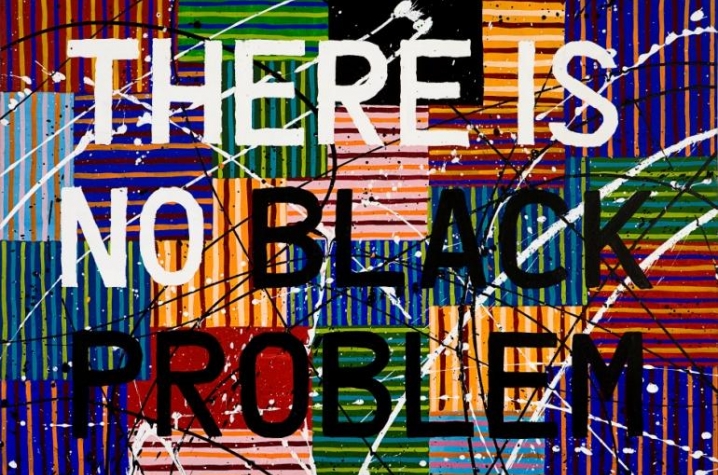

Sociologist Howard Winant writes (in academic speak) “The theme of race is situated where meaning meets social structure, where identity frames inequality.” I would add that the situated-ness of these spaces are encounters between whites and non-whites. These encounters — any and all — are historically loaded. The relationship between white and non-white cannot be unmarked by history and oppression.
Whiteness is a space – a historical space and a relational space.
Whiteness and blackness is about what happens in the in-between. It is a historical space because when I see, greet, or meet a non-white person, I feel the centuries of history bubbled up between us: slavery, Jim Crow, genocide, citizenship, favor, advantages, anger and rage, and ease and dis-ease. My visual reference is Charlie Brown talking about Pig Pen: “Don’t think of it as dust. Just think of it as the dirt and dust of far-off lands blowing over here and settling. It staggers the imagination!”
Can and white and black people be friends? Really good friends?
The answer is, “Of course.” Just look at the growing number of “inter-racial” relationships and marriages. But, the reality is that we whites are statistically the least likely to marry outside of our race. We are less likely to pursue friendships outside of our race than non-whites, as well. As comedian Chris Rock so humorously and honestly stated:
“All my black friends have a bunch of white friends. And all my white friends have one black friend.”
Why is that? Why are white people so (you fill in the blank) about making friends with other non-whites? Even well-meaning, socially conscious, and politically active, whites?
The question is not hard to answer: Because there are risks involved. Those risks are real and not real. Having an intimate friendship with a person of color forces white people to look at their own pre-concieved racist ideas. Yes, racist ideas. And, even more scary than admitting to ourselves that we might be racist, is saying or doing something that is racially offensive.
Which would you rather do? (A) Participate in a multi-cultural sensitivity training at work. (B) Go to dinner at the home of a Black, Hispanic, or Native American colleague that you just met?
The following are questions that might go through your mind:
One could argue that you might ask three-out-of-four of those questions the first time you went to any new person’s house. But would you? Really?
How at ease or comfortable are white people when they are around and outnumbered by non-whites? The risk involved is a risk of uncertainty. The prospect of dis-ease and dis-comfort.
There is an awareness and a scrutiny of the self that occurs when white people are placed in close proximity, in non-working environments, and/or in intimate situations, with people of color. This self-gaze is uncomfortable. It usually leads to self-censorship. It leads to an in-authenticity. It is hard work. It seems easier to walk away.
Don’t! Stay in that space of discomfort. Give yourself permission to be uncomfortable. Most importantly, give yourself permission to make mistakes. Be honest with your friend and colleague if you feel you have said something that was wrong, hurtful, or stupid. That is what relationships and intimacy are about, anyway. Some will work; some will not. That happens in all relationships.
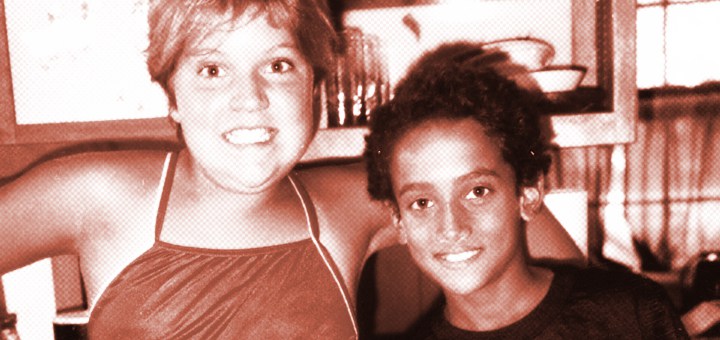


Only white Americans fly the Confederate flag. Why is that?
When my child was writing his essay on the American flag for a class assignment it brought to mind the Confederate flag. During the presidential campaign this past summer, and most recently since the Trump presidency, the Confederate flag has been flown with impunity. I use the word “impunity” on purpose. White people fly the Confederate flag with impunity. White people fly the Confederate flag to make a statement. A statement that directly contradicts and challenges everything that the American flag represents:
“…almost everything we hold dear on earth. It represents our peace and security, our civil and political liberty, our freedom of religious worship, our family, our friends, our home. We see it in the great multitude of blessings, of rights and privileges that make up our country.”
Calvin Coolidge, 30th President of the United States
Or as my apple-polishing kid wrote, “It shows fifty individual states ready for anything that comes at them, in the present or in the future.”
The Confederate Flag in its many incarnations (The Stars and Bars, The Stainless Banner and The Blood-Stained Banner) was the flag used by the “Confederate States” during the Civil War. The Southern states of Alabama, Arkansas, Florida, Georgia, Louisiana, Mississippi, North Carolina, South Carolina, Tennessee, Texas, and Virginia seceded from the Union in 1861 for the sole purpose of preserving the institution of slavery. Their individual declarations of secession cited threats to slavery in their own states and in the new territories.
The Confederate Flag by historical definition is the symbol of the South; the Antebellum South. It is also known by definition as the “Rebel Flag”. It was used by various political parties in the south: in the 1940’s to oppose Truman’s anti-discrimination laws, in the 1950’s to preserve segregation, and in the 1960’s to oppose civil rights legislation.
The Confederate Flag is the divisive symbol of racism. It is no coincidence that it is used by white supremacists groups across the United States.

Why would anyone fly the Confederate flag when it is so closely linked to racist ideologies? Supporters who use the flag often state, “It’s not a racial thing”. Or, “It’s an expression of Southern heritage and Southern Pride”. And, as one Trump supporter tweeted:
“They’re making me take it down because the media is going to spin it into something that it isn’t.”
How else to spin it?
How can you separate the South’s heritage from the South’s history of enslavement and Jim Crow?
An obvious analogy is to ask “Can the swastika be separated from the Nazis?” Of course not. Can the Olympic Rings represent anything other than the Olympics? Hardly.
This is the story of whiteness. To be white and have white privilege is to stand up in a room full of people, look directly into the eyes of brown, black, or red skinned people and tell them what is and what is not racism. White people can ignore history. White people can ignore experts. White people can ignore their neighbors. The power of privilege allows supporters of the Confederate flag to argue that the flag can be a racial slur, but in this moment it is not. In other words, to be white is to assert that ugly, insulting, and racist symbols can be separated from their intention, history, or definition.
As for the Daughters of the American Revolution, those staunch champions of the American Flag, who sponsor middle-school essay competitions across the states, and who publish a leaflet outlining patriotic customs on the flying of our national flag, I asked them if the DAR has an official position on the Confederate Flag. For, is not the flying of the Confederate Flag an act of disrespect towards the National Flag?
In response to my query, Ms. Linda L. Hunt, National Chair of the Daughters of the American Revolution, answered…
“This national chair represents the Flag of the United States and we follow the U.S. Flag Code. We do not comment other flags, i.e. the Confederate Flag.”
12/05/2016
Why the hell not?


“Nobody should be allowed to burn the American flag — if they do, there must be consequences — perhaps loss of citizenship or a year in jail.”
Tweet by President Donald Trump
Last year when my child was in fifth grade the Daughters of the American Revolution sponsored a lesson and essay contest titled What the Flag of the United States Means to Me. He also received a paper booklet named The Flag Code which states the directions for displaying and respecting the flag.
The essay was a required assignment. He wrote his essay without any help. I had no idea what he would write as I had never had a conversation with my kid about the flag; nor do we have a flag flying in our home. He received an A- grade; and on the paper his teacher wrote, “great insight” and “nicely written”. I had to laugh. Part of his essay reads:
“The flag of the USA determines the power in this country. It shows 50 individual, powerful determined states, ready to make a change. It shows 50 categories of inspiring people, ready for anything that comes at them, in the present or in the future, no matter what the sacrifices are. It shows how powerful a country could be. How strong people could be if they work together until the end. It shows that no matter your color, race, or gender, you can come here.”
This assignment has elements of propaganda and hypocrisy. The education and promotion of our flag without any kind of contextual or historical lesson is simplistic, uncritical and insincere. It forwards the idea that flying the flag unto itself is an act: an act of patriotism, an act of obligation, or an act of freedom. And, not doing so is an act of disregard, disobedience, and reproach. The politics of flying the flag has been reduced to the “you are either with us or against” binary which is typical of western thinking.
Lots of flags were flown in the immediate aftermath of 9/11. One could easily argue that doing so was nothing more than a meaningless, empty, gesture.

What is the Purpose of a National Flag?
A national flag is the flag that symbolizes a country and its citizens. It has its origins as a field sign in battle, or as a military standard representing a principality, suzerainty, or dynasty. Outside of warfare the flag became common in the age of sail, as a maritime flag indicating the provenance of the ship. It was during the modern era (1500 B.C.E. to 1800 C.E.) when nation-state boundaries were being drawn that flags were adopted in a civilian and cultural context. The American flag and colors comes from the ensign of the Continental Navy of the North American Colonies.
Simply stated, the purpose of a national flag is to identify national identities. It is a global sign. Kind of like the “Stop” sign or the “Olympic Rings”.
Our nation’s flag protection movement began in 1897 with the adoption of Flag Desecration Statutes. This movement began as reaction to perceived commercial and political misuse of the flag.
WAIT…WHAT?


By 1907 flag desecration laws were promulgated in every state. And in 1942 President Roosevelt approved the “Federal Flag Code” which was when the Pledge of Allegiance was adopted as well. The contentious debate as to whether or not flag defacement and irreverence is an expression of free speech began in earnest during the Vietnam War and ended in the 1990’s when the The Supreme Court ruled twice that destruction of the American flag is protected by the Constitution, specifically the First Amendment’s protection of free speech.
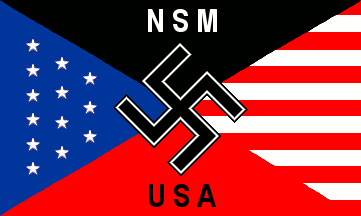
Clearly for our current president, the act of defacing our national flag is unsettling. But only in some contexts and unless you are one of his supporters. Then it is an act of patriotism.



THIS WAS A RECENT DISPLAY IN A MAJOR BIG BOX BOOKSTORE IN ONE OF THE LARGEST CITIES IN THE U.S., WHICH HAS A LARGE AFRICAN-AMERICAN POPULATION.
Answer: Not one book is by an African writer. They are or were all white: maybe not racist, but definitely colonial and paternalistic.

Wow. Ms Muldrow is sure getting a lot of mileage out of this series. There is even a postcard book. And not even one person of color. Egad!


The fifth incarnation of the “Everything I Need to Know About…I Learned From A Little Golden Book” series by longtime Golden Books editor Diane Muldrow is available.
From Amazon: “Have you ever wished your family were a little more . . . perfect? The brand that most represents idyllic perfection actually confirms that there is no such thing. But it does show that joy and love can be found in the imperfect!”
My purpose here is to make visible what is invisible: the unspoken assumption that the world is white and everyone in it is white. That “I” and “We” are white. The writer is white; the reader is assumed to be white; and the cultural and historical references and images are for white people. More importantly, it is expected that African-Americans, Native-Americans, Asian-Americans, Middle and East Indian-Americans, and all other non-white Americans can and should relate.
Like her previous “Everything I Need to Know…” books, Muldrow borrows illustrations from vintage books and adds her own words of wisdom and insight. It begins with an image of the “perfect family” and our collective desire for one:

There are sixty-nine images in total. Twenty are of furry creatures. Five are of non-whites. There is one of a light brown-skinned sleeping baby — which is actually quite sweet — taken from the book Prayers for Children, 1974 . A Hispanic child and baby are taken from Baby Sister, 1986. A charming classroom picture from We Like Kindergarten, 1965, illustrated by Eloise Wilkens, once considered “the soul of Golden Books”, includes a smartly-dressed black boy. The South Seas Island girl, Ukulele, from Ukulele and Her New Doll, is pictured eating with her family. (She and her family are lighter-skinned than their 1951 counterparts.) And lastly, there is a colorful drawing of a brown father and child. The only non-Golden Book image; probably added for the sake of posterity.
I am sure Little Golden Books is not consciously trying to re-write history. Nor would they argue that America belongs to white people. But, if they believe that this book, with its images of a white-remembered and longed-for past does not make a statement, then they are sadly mistaken.
As I wrote earlier, the 1940’s, 50’s and 60’s were difficult and painful times for many Americans, but mostly for non-white Americans: segregated armed forces, Jim Crow, Indian Schools, overt educational and housing discrimination, forced resettlement of non-white cultures, and many other prejudices. Not to mention their absence of representation in politics and other positions of power and authority. Times continue to be difficult for non-whites. Racism, prejudice, and discrimation still exist.
Again, Memory Lane for Whom?
“Everything I Need To Know I Learned From A Little Golden Book is so overwhelmingly white-centered it pains the eye and pierces the soul of the millions of us who cannot, will not, claim that level of unconsciousness.”
Alexis DeVeaux
This book is for white-Americans only. For it is their imagined past that is getting re-written, glorified, and made nostalgic. That is why white Americans gobble this book up.
Nothing in this book is true or compelling. It is exclusionary. It is about who is inside and who is outside. It contributes to the cultural climate and the belief that real Americans are white.
Why else was President Obama’s citizenhship questioned?

The “I” is White

Everything I Need to Know I Learned from a Little Golden Book by Diane Muldrow is a New York Times best seller. The book offers life lessons reduced to simple maxims: “Is your life starting to feel like a circus? Don’t panic…today is a new day!” Illustrations from Little Golden Books created between the years of 1942 to 1963 capture the spirit of the advice. The Pokey Little Puppy reminds us “to stop and smell the strawberries” and Tootle the Train demands that we “Frolic!” Favorite classic images instruct you to “Treat yourself” and “Kiss”.
Admirers of the Little Golden Books – the cardboard books with the gold foil spine – claim that the books have been uplifting people since World War II and that they still have much to teach. Muldrow reminds her readers that “our country has faced hard times of late.” She proclaims, “The chickens have come home to roost, and their names are Debt, Depression, and Diabetes.”
“Who is this book really for?”
There are seventy-eight illustrations in the book; thirty-eight have pictures of people. Of those thirty-eight, only two images include non-whites: Black folks are religious, right?
Memory Lane for Whom?
“Everything I Need To Know I Learned From A Little Golden Book is so overwhelmingly white-centered it pains the eye and pierces the soul of the millions of us who cannot, will not, claim that level of unconsciousness.”
Alexis DeVeaux
The 1940’s, 50’s, 60’s were difficult and painful times for many Americans, but especially for African-Americans. Between those years over forty black men and women were lynched, Jim Crow law in the south was legal, and until 1964 blacks were denied the fundamental right to vote. The armed services were desegregated in 1948 and schools were desegregated in 1954. But African-American soldiers and students still faced violence, bullying, or insult.
Other non-white cultures and identities were vilified, ignored, or made invisible. Japanese-Americans went from citizens to enemies. Native American children were forcibly sent to “Indian Schools” while their families were relocated to urban areas. Latinos, with the exception of saucy actresses and Desi Arnaz, were largely ignored. And, Puerto Rico was a colony with limited self-government.
A friend who is black, over fifty, and prefers to remain anonymous said, “As an individual, I do not see myself or my experiences in this book… I am not to the point of hating it, but it has nothing to say to me”.
Reviews of the book read like glowing advertisements. The Huffington Post writes: “Offers simple advice that is also very wise.” Publishers Weekly declares: “An optimistic and cheering trip down memory lane”. And the School Library Journal states “A fun and entertaining walk down memory lane.”
It scares me to know that this book was so well received by the white American public and was such a hit that the author was able to publish a series – a series that seems never ending.

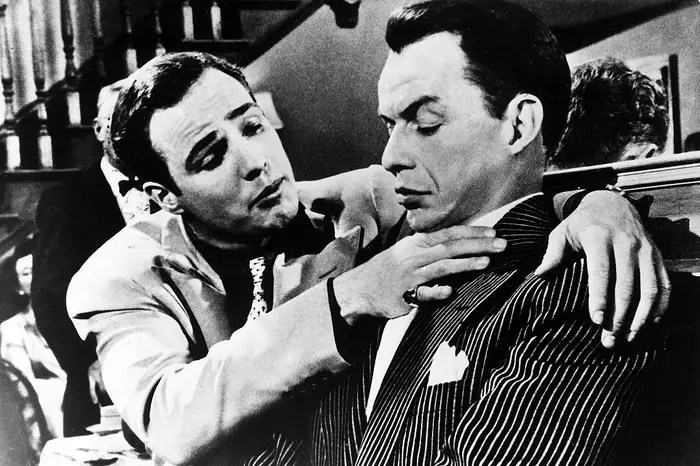


 Beth Kwiatek